
Species Study
There are 1,400+ species of bats in the world. This is one of them.
Brazilian funnel-eared bat with its wings spread

Brazilian Funnel-eared Bat

Cave conservation key to protecting species
By Lindsay Lee Wallace
bat stats
Bat icon
Binomial

Natalus macrourus
Two bats icon
Family

Natalidae
Bat Globe icon
Colony Size

Usually, these bats live in colonies of 10 to 20, although in some ideal habitats—such as one Brazilian cave that’s home to a river—they have been observed in much larger numbers.

Scale icon
Weight

Six grams
Bug icon
Diet

Insectivorous
Exclamation Point icon
Status

Near Threatened on the IUCN Red List, considered Threatened in Brazil
Region

In South America south of the Amazon River in the countries of Bolivia, Brazil, and Paraguay
Black silhouette of South America and parts of North America on a yellow background.
Photo: Jennifer Barros, Ph.D.
S

ometimes people have negative sentiments about bats that arise from stereotypes and misinformation, which can breed fear. But when Bat Conservation International (BCI) Brazil Program Manager Jennifer Barros, Ph.D., is talking about bats with people, she knows how to break down some of these barriers.

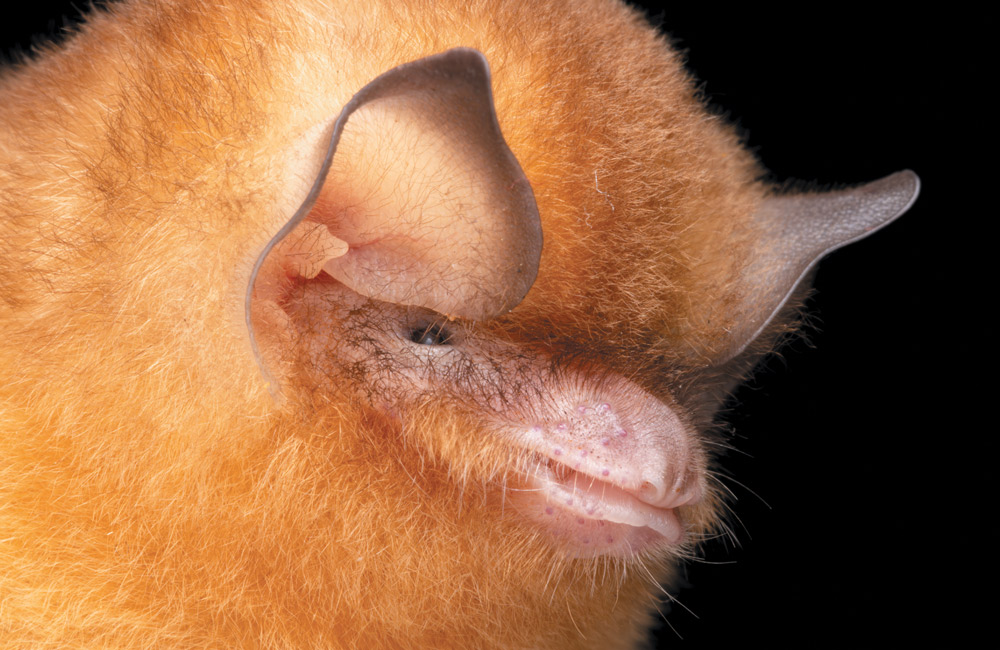
Her secret weapon is Natalus macrourus, or the Brazilian funnel-eared bat. Orange, yellow, or white in color, weighing in at just six grams and adorned with a unique nasal ridge called a natalid organ, this bat is a star of Barros’s outreach.

“When you’re showing pictures of Natalus, because it’s a really cute bat, this starts to change people’s fear and negative views about bats, and it’s an interesting thing to see,” Barros says.

She has also found success discussing the many benefits these bats, and other species, provide to people and the ecosystem.

“They eat insects, which helps with agriculture, so farmers can use less pesticides,” Barros says. “If you like tequila, the bats are pollinating the agave plant. So it’s all things they can relate to.”

By encouraging a shift in sentiments toward the Brazilian funnel-eared bat and other species throughout Brazil, Barros aims to garner support and understanding for conservation efforts—especially those focused on the country’s many caves.

The importance of hot cave conservation

The Brazilian funnel-eared bat is listed as Near Threatened on the IUCN Red List, and is considered officially Threatened in Brazil due to the threat posed by mining, agriculture, and deforestation in its habitat and foraging areas.

Barros says the best way to protect these bats is by protecting the caves where they roost. She leads BCI’s cave conservation efforts in Brazil, work that stems naturally from the research she’s been conducting since her time in university when she was a BCI Student Scholar.

Close-up of a bat with fluffy orange fur and prominent ears.
Natalus macrourus
Photo: Jennifer Barros, Ph.D.
“I work in caves to understand the relationship between bats and caves so we can support strategies for conservation,” she says. Nearly half of Brazil’s bat species rely on caves to roost, including the Brazilian funnel-eared bat.

Hot caves are especially important for some of these species, but they are also among the most fragile ecosystems. These caves are home to species that require temperatures between 28 and 40 degrees Celsius (82.4 to 104 degrees Fahrenheit). The caves tend to have small entrances and low airflow, which are characteristics that help maintain the temperature. They are home to thousands of bats. The large number of bats in these caves increases the temperature in their chambers, and the huge amount of guano they produce increases the temperature even more.

“The species that form these large colonies do it for the survival of their pups, which are born without fur,” Barros says. “They need to stay in the cave while they’re still developing, so the temperature of the cave needs to be around the body temperature of the pups for them to survive.”

Hot caves also often feature a temperature gradient between the colony chamber and other parts of the cave structure. This means several species can share habitat. Barros says that as the climate becomes more volatile, the stability provided by caves will be more important than ever.

I work in caves to understand the relationship between bats and caves so we can support strategies for conservation.
—Jennifer Barros, Ph.D.

Tools for finding bats

Many times, it’s hard to find these bats in a cave. While the Brazilian funnel-eared bat is the species of the Natalidae family with the widest geographic distribution, sightings are rare. Barros says that if her team were to survey 20 caves, just one might be home to the bat. And even once her team is inside the cave, they might have trouble locating the roost because of the bat’s small size and the fact that it generally lives in colonies of only 10 to 20 animals.

“Sometimes, you’ll get into the cave and they’re hiding,” she says. “It’s not easy to find a cave, and then it’s not easy to find them in the cave.”

One tool that’s come in handy for locating caves where the Brazilian funnel-eared bat lives has been ultrasonic bat detectors. These devices can pick up on the bat’s high-pitched calls and record them to show scientists where the bats are present in addition to providing other information about the species.

Using these tools, Barros and her team have successfully located multiple caves that are home to the Brazilian funnel-eared bat, including an unusually large colony of hundreds, all gathered to roost above a river that runs across the cave floor.

While finding the bats remains a challenge, Barros and her team continue to search for caves that could be good habitat for these and other bat species, and they are also working to protect these areas to provide habitat for Brazilian funnel-eared bats and the many other species that rely on these caves.