leaf iconFeature: Bat Taxonomy

1,500 Bat Species and Counting

bat illustration
1,500 Bat Species and Counting
Himalayan long-tailed bat (Myotis himalaicus)
Photo: Rohit Chakravarty
T

he moment Rohit Chakravarty, Ph.D., saw the bat in the mountains of India’s Uttarakhand state, he knew it was the one he had been seeking for four years. He’d last spotted the species years before, and Chakravarty was eager to examine what would soon be named the Himalayan long-tailed bat (Myotis himalaicus). Chakravarty is Bat Conservation International’s (BCI’s) India Program Manager, and he joined taxonomist Uttam Saikia, Ph.D., and the rest of their team in the field that day to examine the bat they’d carefully netted, evaluating its measurements and the shape of its head and teeth.

“Our team was able to work out a suite of external, cranio-dental (head and teeth) and bacular (penis bone) characteristics unique to this species,” Saikia says. “Supported by genetic data, we were able to confirm that it indeed belongs to a new species.”

Recognizing different species, especially cryptic species, continues to be vitally important for conservation efforts by defining the scale of diversity we need to protect.
—Winifred Frick, Ph.D.
Mylea Bayless, BCI's Chief of Strategic Partnerships, is shown conducting field research. She is wearing a headlamp, a black face mask, and two different-colored gloves while carefully measuring a small bat using a digital caliper. The bat is resting on a white cloth on a table in front of her.

Mylea Bayless, BCI’s Chief of Strategic Partnerships, measures a bat.

Photo: Rachel Harper

Identifying bats is a challenge for scientists, who often use multiple methodologies, including charting each bat’s physical characteristics and analyzing its genomic information, to discover if it is truly a species not yet described by science. Comparing samples to museum specimens of previously recognized species is also a key way to determine if a species is new to science. More than 1,500 unique bat species are known to science, though the number continues to increase each year as more species are described.

Identifying distinct bat species is important for many reasons, including conservation.

“Recognizing different species, especially cryptic species, continues to be vitally important for conservation efforts by defining the scale of diversity we need to protect,” says BCI Chief Scientist Winifred Frick, Ph.D. BCI tracks the latest information on bat species diversity in order to ensure bat conservation efforts are targeted to benefit bat diversity.

Using multiple identification methods

The methods the team used to identify the Himalayan long-tailed bat were a combination of traditional and more modern bat identification techniques that perfectly illustrate scientists’ ability to tease out the subtle identifiers that distinguish a bat species.

“The best case is where the bat looks different, behaves differently, and has a different genome,” says Nancy Simmons, Ph.D., Curator at the American Museum of Natural History and BCI Board Member.

If a bat is markedly different in every way from known species, that makes it easy to determine its newness.

“But in the real world, we don’t often have all of that,” Simmons says. Identification can be challenging because closely related bats can look very similar to one another, making identification in the field using physical traits difficult, and researchers do not always have access to samples for DNA comparisons. “How much difference is enough to tell us if this is really a different species?” Simmons says.

bat in flight icon
Find the most up-to-date bat species count: batnames.org

Behind the Bat Database

When Nancy Simmons, Ph.D., first began working on the project that would become batnames.org, it was entirely analog. At the time, it was a list managed and published by Karl Koopman, Ph.D., a “hardcore taxonomist” and curator at the American Museum of Natural History (AMNH).
A head-and-shoulders portrait of Nancy Simmons, Ph.D., who is looking slightly off-camera and to the left. She is a white woman with short, brown hair, wearing a patterned sleeveless red-orange top and a small silver hoop earring. A partially visible banner or sign is in the blurry background on the right.

Nancy Simmons, Ph.D.

Photo: Rachel Harper
After Koopman passed away in 1997, Simmons was asked to take over authorship of the project. She inherited Koopman’s copy of the book and found it full of his meticulous notes. “He had scratched things out and written little notes in the margins as things changed, because new papers come out all the time,” she says.

When she was finally finished updating the list for the 2005 version, she knew she had to digitize the project. “I thought, ‘That was a tremendous amount of work. I would hate to ever get behind again.’” From then on, she kept the regularly updated list in a file on her computer.

That worked until the number of people reaching out to her with bat questions hit critical mass, and she realized it was time to shift strategies once again. She teamed up with Andrea Cirranello, Ph.D., an AMNH Research Associate, and batnames.org was born. The website now serves as a reliable source for researchers, scientists, and anyone else curious about the exact names of the world’s ever-evolving list of bat species. The count recently topped 1,500 and is increasing.

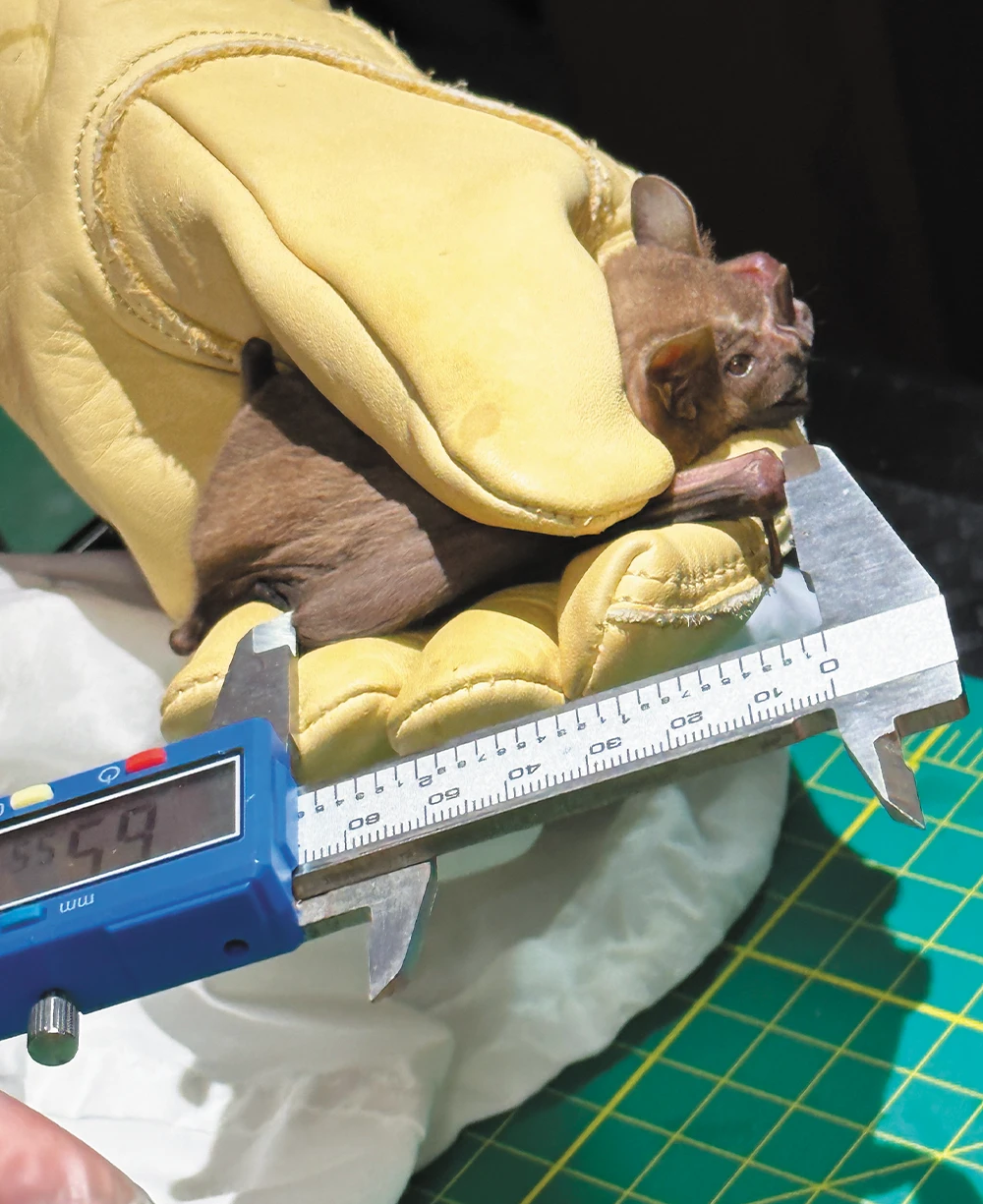
A close-up image showing a scientist measuring a small, brown bat held in a thick, tan leather glove. The bat is nestled in the gloved hand, while a blue digital caliper is used to measure its forearm or wing length.
Measuring a bat is one of the ways scientists determine what species it is.
Photo: Rachel Harper
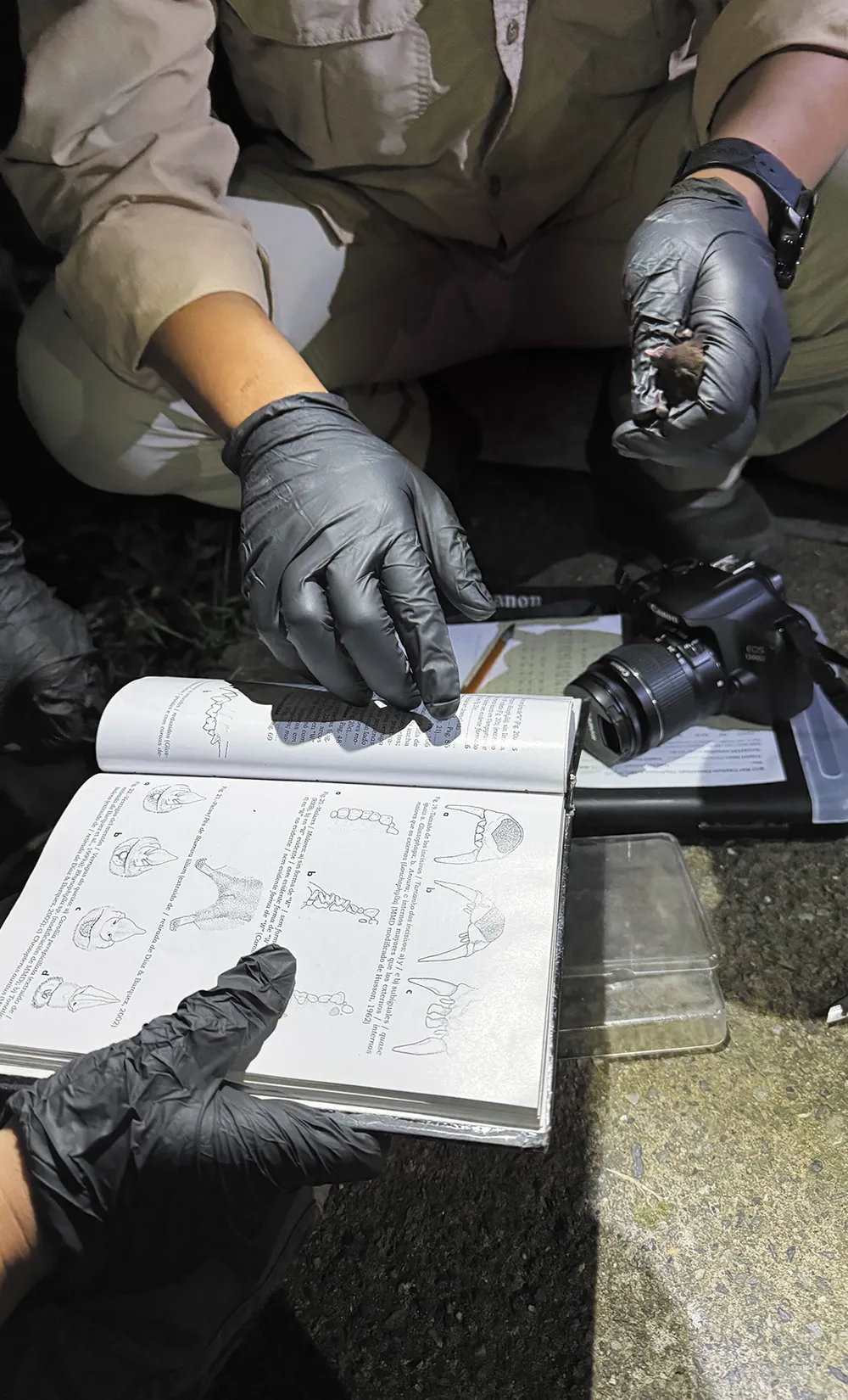
An overhead photo showing two scientists in the field at night, both wearing black nitrile gloves and tan field clothes. One scientist holds a small bat in their gloved hand while the other consults an open field guide to identify the species. The guide displays scientific diagrams of different bat heads and anatomical features.
Scientists examine a bat’s anatomical features and consult published guide books and keys to determine what species it is.
Photo: Emily Ronis
That’s why identifying a bat is an impressive and ever-evolving science that utilizes multiple methods.

Simmons, who runs the database of known bat species called batnames.org, knows firsthand how critical these choices can be. She formed the Global Bat Taxonomy Working Group, a formal committee of the IUCN Bat Specialist group, to help grapple with decisions regarding which new discoveries should make it into the database. The group considers newly published bat research to determine if the data and methods are sound enough to justify the claims being made.

“In some cases, it takes a lot of discussion,” she says. “We go back and reread a bunch of papers, and eventually we come to, ‘Alright, this is our best guess.’”

Historically, most bats were identified by external morphological traits, including the distinctive physical characteristics that Chakravarty, Saikia, and their team, including Manuel Ruedi, Ph.D., and Gabor Csorba, Ph.D., found during their examination of the Himalayan long-tailed bat’s head, teeth, and pelvis.

These morphological traits also helped the team figure out that an unidentified specimen that had been caught by Gábor Csorba, Ph.D., in 1998 was also a Himalayan long-tailed bat.


Advancements in genomics bolster science

However, identifying bats just by physical characteristics can be a challenge. “We’ve come to learn that there’s a lot of cryptic species diversity if we just look at the external morphological traits of bats,” Frick says. “By using modern genomic and genetic tools, we can see the species divergence in the genomes of bats, and that’s provided a much fuller picture of the level of diversity that we have.”

This fuller picture also helped BCI discover Nimba myotis (Myotis nimbaensis) in 2021. The little orange bat, discovered in Guinea’s Nimba Mountain, was captured during surveys of old mining tunnels.

A striking close-up of a Nimba myotis (Myotis nimbaensis), a species BCI discovered in 2021. The bat is held securely by a hand wearing a green and leather glove over a blue glove. The bat has bright orange-red fur on its head and body, prominent dark ears, and two distinct clawed thumbs visible at the top of its head.
BCI discovered Nimba myotis (Myotis nimbaensis) in 2021.
Photo: Jon Flanders, Ph.D.
A full-length photo of two scientists, Rohit Chakravarty, Ph.D. (in red), and Zareef Khan (in gray), standing in a shallow, rocky stream in a lush natural environment. They are smiling and looking at the camera; Khan holds a long wooden pole, likely for setting up mist nets. The stream bed is filled with large, smooth, gray boulders, and the background is forested.
Rohit Chakravarty, Ph.D., and Zareef Khan netting bats near where they found the Himalayan long-tailed bat.
Photo: Farah Ishtiaq
“When I first started working with bats, the only way you could build a family tree of a set of organisms was using morphology, so anatomical traits,” Simmons says. Today, genomic methods that classify bats by analyzing their DNA are getting more sophisticated every day. “You can use a single gene to figure out where an animal goes amongst close relatives,” Simmons says. “Or you can use the entire genome, which is the direction we’re moving in now.”

Genetic analyses of different kinds can also reduce the number of bats that need to be captured for research purposes. Scientists have recently discovered that environmental DNA (eDNA) naturally shed by bats can be used to study their habits and migration patterns. For example, bat species visiting hummingbird feeders can be detected by swabbing the feeder the next day. Of course, scientists can’t build a genetic database to compare samples to without catching bats. But while capturing and keeping the whole bat used to be standard, today’s methods often make it possible to gain plenty of information by collecting a small tissue sample and other methods.

For many scientists, these advances have been career- and even life-defining. Saikia says, “Beyond the personal satisfaction of discovering a new species, I am happy to collectively contribute to our understanding of a fundamental question, ‘What lives on earth?’”
bat in flight icon
Learn about Myotis nimbaensis: batcon.org/bat/myotis-nimbaensis