

Bat Chat A Conversation with a noted expert

A Budding Bat Conservationist

MENTOR-Bat fellow Maria Suhatri develops a bat conservation program in Indonesia
By Stefanie Waldek
T

he Critically Endangered Sumatran orangutan is one of Indonesia’s flagship species, and environmental educator Maria Suhatri is doing her part to protect them. She serves as Education Manager at Orangutan Haven in Medan, Indonesia, a protected wildlife ecopark and education center housing rescued orangutans that can’t be released back into the wild.

A person with short dark hair smiling in an outdoor setting with blurred greenery in the background.
Maria Suhatri
Photo: MGambaRios
Maria is also a fellow in the Indonesia cohort of MENTOR-Bat, Bat Conservation International’s program dedicated to supporting the next generation of global conservation leaders. So how does an orangutan conservationist fit into the picture of bat conservation? Read on to find out.

Your background is in orangutan conservation—how did you get interested in bats?

I’m working for an organization called Yayasan Ekosistem Lestari (Foundation for Sustainable Ecosystem), which focuses on Sumatra. I specifically work at Orangutan Haven, where you can see rescued orangutans in a natural forest setting that are unreleasable because they have physical and mental trauma.

But here, it’s not just about orangutans. We plan to create a fruit bat enclosure to share the important role of bats in the ecosystem, but no one in our organization has experience working with bats. That’s why I joined MENTOR-Bat—to learn more about bat conservation and be able to lead and manage our bat conservation program at Orangutan Haven.

How has your experience in the MENTOR-Bat program been?

I’ve learned a lot about bat conservation already. We had six months of training online, and much of it focused on bats and bat conservation. We’re also developing skills in communication and leadership, which is interesting for me since I’m an early career professional. I feel that MENTOR-Bat is increasing my capabilities as a professional in conservation.

Joining this program has also been a really great opportunity to grow my connections because it’s not just based in Indonesia, but a global program. It’s been an honor for me to join MENTOR-Bat to expand my network.
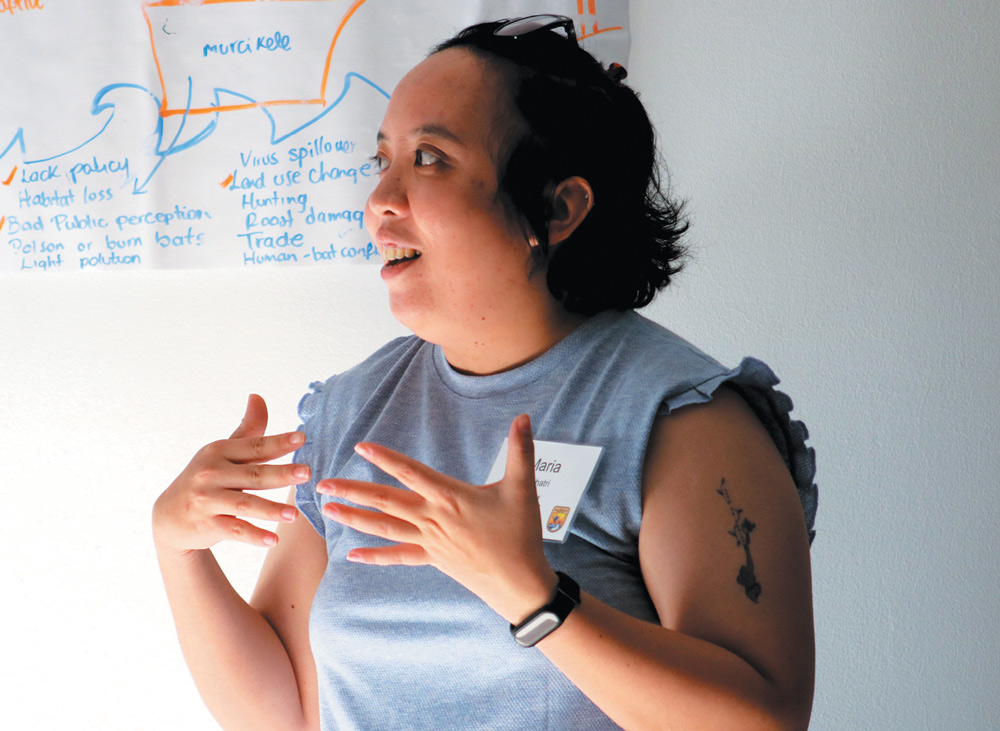
A person gesturing while speaking in front of a whiteboard filled with handwritten notes.
Maria Suhatri is an environmental educator in Indonesia.
Photo: Emily Ronis, USFWS

How are you applying what you’ve learned in the MENTOR-Bat program to your conservation work in Indonesia?

From my experience, I find that most people in Indonesia only know about fruit bats. They don’t really know about other bats, especially the ones that eat insects. They think they’re birds, not mammals. Overall, they don’t know that bats help the ecosystem, so they think bats aren’t good animals, but it’s just an oversight.

When we do awareness outreach, people are willing to learn about how bats help us, from dispersing fruit seeds to pollinating fruit flowers and how insect-eating bats are helpful for pest control. Peo ple also don’t know that guano can be used as a fertilizer, which is what our project is focused on.

What advice do you have for students or early-career conservationists seeking mentorship in their respective fields?

Challenge yourself to apply to any kind of program like MENTOR-Bat, because if we never try, we’ll never know.