


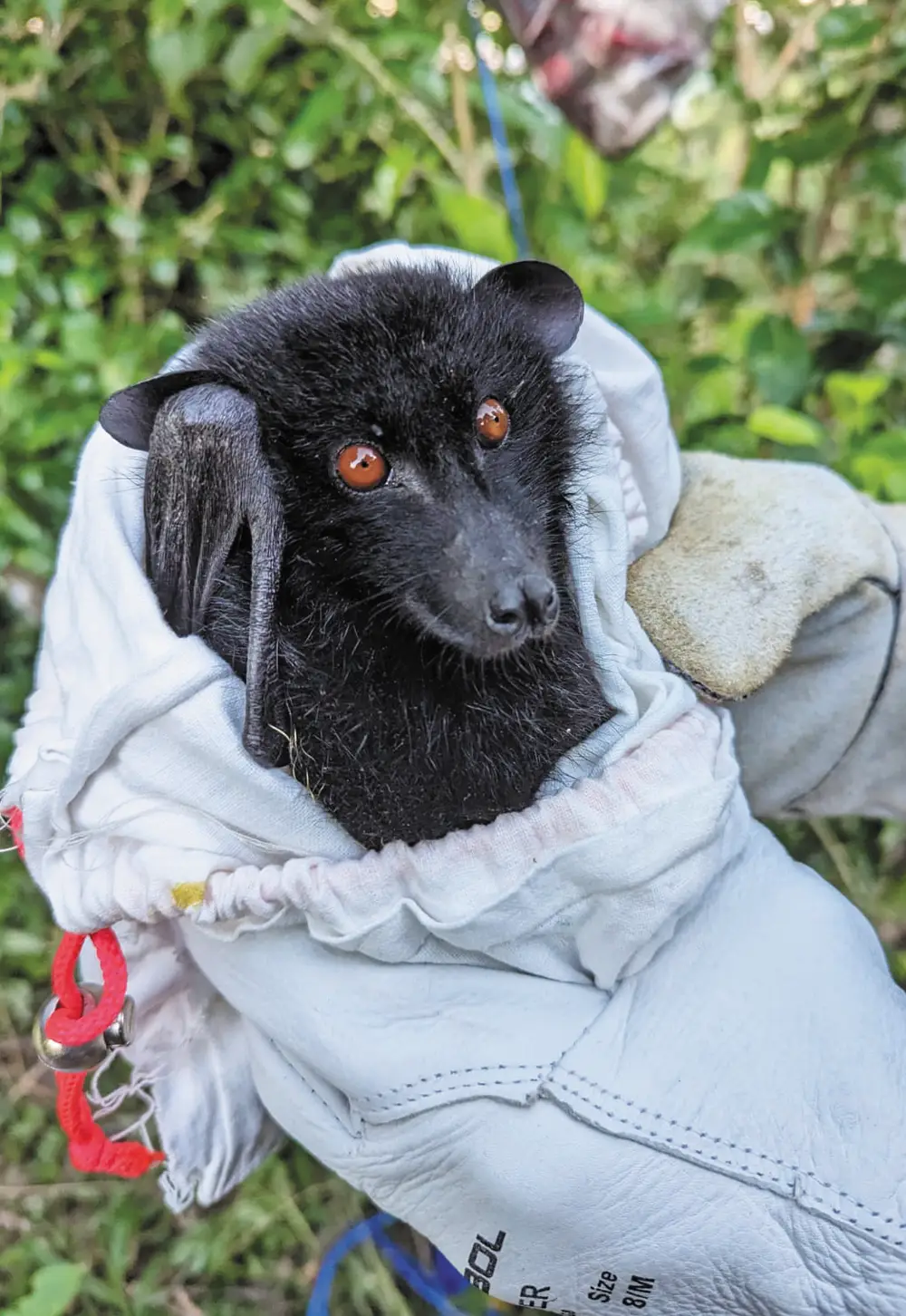
Hope in the Comoros
It lives in a remote part of the world off the eastern coast of Africa between Madagascar and Mozambique where a small chain of four volcanic islands makes up the Comoros Islands. The northern three islands, including Anjouan, comprise the Union of the Comoros, and it’s here, in this lush and rugged landscape, that the bat’s fragile future is being shaped. For decades, this species hovered on the edge of extinction. Now, there is a cautious reason for hope.
In May 2025, the International Union for Conservation of Nature (IUCN) downlisted Livingstone’s fruit bat from Critically Endangered to Endangered, a shift made possible by years of meticulous fieldwork and grassroots conservation. Local non-governmental organization (NGO) Dahari has led the effort, with support from Bat Conservation International (BCI).
“Dahari’s decade-long monitoring work was critical to this species’ downlisting,” says BCI’s Regional Director for Africa and South Asia Isabella Mandl, Ph.D. “They conducted population counts at all known roost sites twice a year.”
That commitment, combined with BCI-funded GPS tracking studies, led to the discovery of previously unknown roosts and a better understanding of how the bats use fragmented forest landscapes. Robust population data helped inform IUCN’s reassessment, offering a clearer picture of the bat’s actual numbers and stability. Dahari also established a strong partnership with the Mohéli Marine Park, coordinating efforts to monitor the entire bat population across the two islands where the species is endemic. This broader monitoring network is crucial for detecting changes quickly and guiding conservation actions as needed.
But fieldwork here is no easy task. “The island is steep, and the bats are difficult to access,” Mandl explains. “In some cases, we have to reach the observation point, or the closest village, the night before the survey to be on-site on time the next day. During our GPS tracking study, we often spent nights camping near roost sites, trying to capture bats at 3 a.m.”
Today, conservation agreements protect seven of the 26 known roosts. Dahari’s community-based approach in protecting the sites provides tangible benefits to landowners, including cash payments for visits and agricultural support in exchange for forest protection and regeneration.
Despite the downlisting, the work is far from over. Dahari Co-Director Hugh Doulton says the NGO is currently testing the use of conservation agreements on wider forest areas that are important for bats, general biodiversity, and water provisioning.
“We want to be able to prove the impact of the agreements before we take them to scale. The illegal wood trade is a major source of timber in these areas and a risk to the agreements,” Doulton says. “So we are undertaking studies to think about how best to find solutions for those people who gain significant revenues from the trade.”
Finding that balance may one day transform a story of near-loss into one of survival.