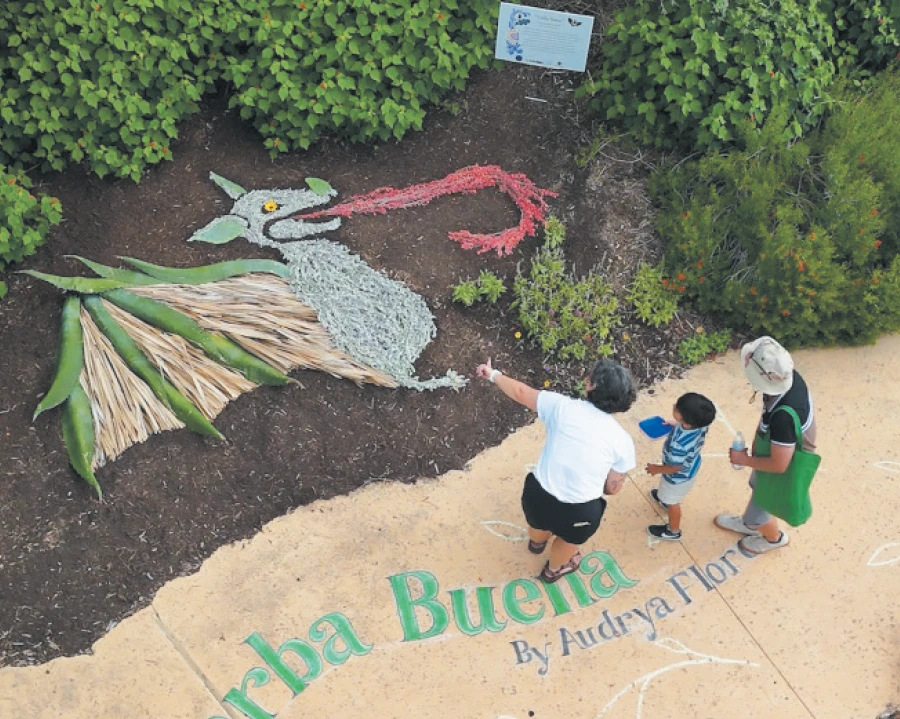
“I want viewers to feel childlike wonder,” Flores says. “I hope they feel a sense of connection to nature. I hope my work highlights how fleeting and precious the birth, death, and rebirth cycles in nature really are.”
To create her ephemeral art piece, an 8-foot-by-12-foot sculpture which she calls “Yerba Buena,” Flores used prickly pear cactus, agave, cenizo (Texas sage), palm fronds, milkweed seed pods, red yucca flowers, and sunflowers, all gathered from around her home base of San Antonio. She forages in parking lots, wild grassy areas, and even from around the locally beloved Sala Diaz Art Gallery palm tree.
“I try to let the plant materials guide me,” she says. “Flexibility is key. I adjust my design to work with the particular shape or texture of a given plant.” Originally, she intended to use cenizo for the bat’s wings but quickly pivoted. “When handling it, I realized its soft, fluffy feel would be perfect for bat fur.”
It’s this sensitivity to material and place that makes Flores’ work feel alive—vulnerable, even. Her sculptures are not meant to be preserved in climate-controlled galleries. They’re designed to decompose. “It’s really bittersweet,” she says. “I put so much thought and planning into a design. Lots of effort goes into it, so it’s always a little sad knowing it will disappear. But overall, I think the process is beautiful. In death, the work will feed the land it came from.”
During the week of installation, nature itself became a collaborator. “The heat and humidity were pretty brutal,” she recalls, noting thunderstorms also interrupted the workflow.
More than sculpture, Flores’s work is environmental storytelling. Her subjects, including bats, owls, snakes, and succulents, are chosen with reverence. “These beings have been my teachers and guides in so many ways,” she says. “They each share a unique type of medicine.” For Flores, bats represent regeneration and pollination, but also myth and mystery, symbols that embody both ecological function and spiritual resonance.
Rooted deeply in place, her artistic practice honors the resilience of plants and animals that endure the Texas heat. “This land is sacred,” she says. “And so are the plants and animals that exist here.”
What starts as sculpture ends in soil. It’s art, not just about nature, but of it, with it, and for it. As the bat slowly fades, its wings curling under sun and time, it tells a quiet story: Nothing lasts, but everything returns.