


field notes
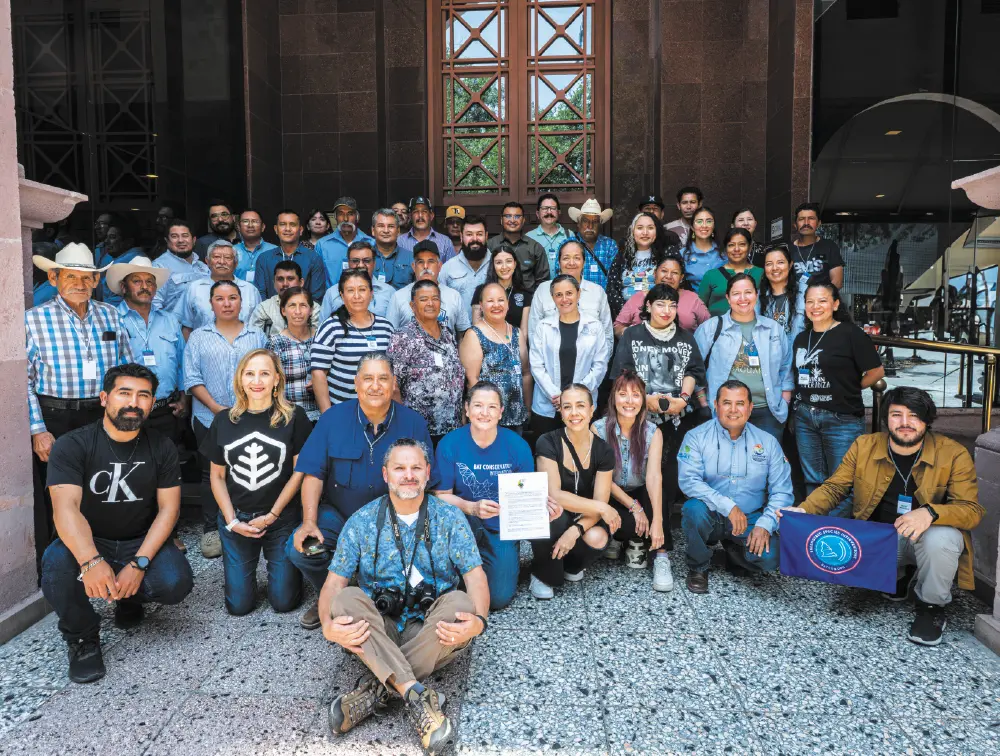
Photograph of a large group of approximately 40 to 50 diverse people who are gathered for a group picture outdoors in front of a stone building with large windows; Many people are standing in the back, while a smaller group is kneeling or crouching in the front; One woman in the center is holding a framed document; All these individuals pictured here happen to be BCI and partners gathered together to focus on protecting agave for bats
BCI and partners gather together to focus on protecting agave for bats.
Photo: Isai Dominguez

Protecting Bats in Mexico

Two events celebrate significant progress for Mexican bat conservation
By Stefanie Waldek
One standout initiative of Bat Conservation International (BCI) is its binational work that includes projects in the U.S. and Mexico. Recently, two major events marked critical milestones for BCI’s work in Mexico: The third Northeast Mexico Agave Restoration Network (NMARN) meeting held in Monterrey, Mexico, and a formal certification ceremony for a bat roosting site in Chihuahua.

Together, these two events showcase BCI’s multifaceted conservation strategy in Mexico. From restoring agave corridors to protecting critical roosting sites, BCI’s success is rooted in collaboration between governments, non-governmental organizations (NGOs), scientists, and most importantly, the communities that call these landscapes home.

Strengthening the Northeast Mexico Agave Restoration Network

In June 2025, partners from across northeastern Mexico gathered in Monterrey for the third convening of the NMARN. BCI launched the initiative in 2019 to protect foraging grounds for the Endangered Mexican long-nosed bat (Leptonycteris nivalis), a migratory species that feeds on agave nectar across northeastern Mexico and the southwestern U.S.

Stakeholders included ejidos (community landowners), local NGOs, and government agencies. At this year’s meeting, these partners shared their progress on actions including habitat restoration, sustainable business development, and environmental education campaigns.

For the first time, ejido members from a region known as Sierra La Mojonera presented their own work. “These are rural farmers, really tough guys, who are very shy in public,” says BCI’s Regional Director for Mexico and Latin America Ana Ibarra, Ph.D., who has long worked with this group. Initially, they didn’t care about bats. But times have changed. “A 67-year-old ejido member presented how the group now goes, by themselves, to monitor the colony they have on their lands,” Ibarra adds. “He explained what he feels when he’s out there counting thousands of bats coming out of the roost. It was so heartwarming.”

The meeting also solidified the coalition’s future. Currently, the NMARN is an informal group led by BCI, but partners agreed it was time to create an official network with rules and structure. At the meeting, partners signed letters of intent to join and develop a formal network.

A landmark recognition

BCI is actively working to protect bat roosting habitats in Mexico, and this initiative took center stage on May 22, 2025, during a formal recognition event in Chihuahua for one of Mexico’s most important bat roosting sites: the Santa Eulalia Caverns.

“Around two years ago, BCI launched a cave conservation strategy in Mexico,” Ibarra says. “The first step for us was to diagnose and prioritize roosting sites that need immediate protection.” Through a combination of fieldwork, published studies, and partnerships, BCI identified 29 sites across Mexico in need of urgent conservation action. In 2024, BCI submitted proposals for 10 of them to be recognized by the Latin American and Caribbean Network for Bat Conservation as Sitios de Importancia para la Conservación de los Murciélagos (SICOM), or “important sites for the conservation of bats.” All 10 were certified. “As a frame of reference, before 2024, Mexico only had one site of importance recognized,” Ibarra says.

leaf icon
In 2019, BCI launched the Northeast Mexico Agave Restoration Network to protect foraging grounds for the Endangered Mexican long-nosed bat (Leptonycteris nivalis). In 2025, partners voted to strengthen and formalize the network.
To celebrate the SICOM designation of the Santa Eulalia Caverns, the Universidad Autónoma de Chihuahua, BCI’s main local partner, hosted an official certificate presentation that drew state government officials, environmental agencies, and community stakeholders. The certification offers more than recognition—it provides the framework for future legal protections. “Now, we are moving forward with the state government and local partners,” says Ibarra, who looks forward to working with partners to protect this special area.