


bat signals

Saving Bats in Singapore

University students form bat rescue network
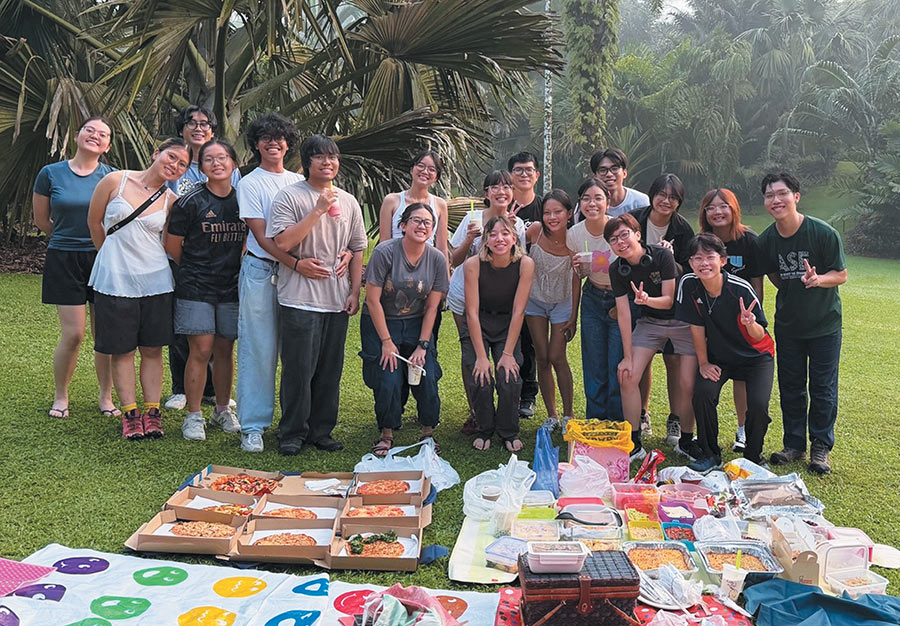
A group of people standing together outdoors behind a picnic spread on the lawn.
Students at Singapore’s Nanyang Technological University formed an observation network to monitor grounded bats
Photo: NTU Grounded Bat Surveys
When undergraduate student Emma Chao entered Nanyang Technological University (NTU) in Singapore, she learned from senior students that there were numerous grounded bats on the campus. She joined with other students to start formal monitoring based on their observations.

The students established a Bat Response Hotline that takes reports of grounded, injured, and dead bats. The group also conducts regular monitoring efforts and surveys. Most of the bats they find are young Javan pipistrelles (Pipistrellus javanicus), with occasional reports of other species. Doctoral student Nicole Dorville is helping oversee their efforts.

Chao’s surveys began in 2024. Today, 40–50 students assist with monitoring, response efforts, and walking transects in search of grounded bats. When they find a bat in need, they conduct no-contact measurements and observations and alert local wildlife officials. The students aim to conduct a monthly bat census, through which they hope to learn more about groundings, urban bat viability, and animal fitness.

Leaf Architects

Documentary explores the world of tent-making bats
A researcher examining large palm leaves in a dense tropical forest.
National Geographic Explorer Bernal Rodríguez Herrera, Ph.D., studies tent-making bats in the documentary “Leaf Architects.”
Photo: Jose Gabriel Barquero
While many bats roost in caves, tree cavities, or human-built structures, some bats in Central and South America build their own homes using leaves.

National Geographic Explorer Bernal Rodríguez Herrera, Ph.D., studies all 22 known neotropical tent-making bat species, and his work is showcased in a new documentary film. “Leaf Architects,” which was funded by the National Geographic Society, shares his work, research, and fascination with these incredible bats.

“What amazes me most is their ability to build these shelters in the dark, often at night, without any measuring tools,” he says. “Even after years of studying them, there are still many questions that continue to spark my curiosity.”

Watch the documentary: filmfreeway.com/LeafArchitects

Celebrate Bat Week

Plus, get ready for the International Year of the Bats 2027
A circular logo for "International Year of the Bats 2027" featuring a flying bat over a globe.
The last week in October is the time we come together to celebrate Bat Week and all the reasons we love bats. Bat Week takes place Oct. 24–31. Plan your own Bat Week event, find an event near you, participate in community science projects to help bats, advocate for bats, and learn about bats during this week of bat appreciation.

Next year is the International Year of the Bats, with even more opportunities to celebrate these incredible winged mammals. Now is the time to start planning how you will celebrate bats throughout 2027.

Learn more at batweek.org and yearofthebats.org

Follow #IYBats on social media to stay up to date: facebook.com/IYBats and instagram.com/internationalyearofthebats

A panel of speakers seated at a table during the COP15 wildlife conservation conference.
BCI scientists and colleagues present the importance of bat mitigation policy to support global expansion of wind energy.
Photo: Winifred Frick, Ph.D.

BCI on the International Stage

A win for bats at the UN Convention of Migratory Species meeting
In March, several BCI representatives attended the Convention on Migratory Species (CMS) Conference of the Parties 15 (COP15) meeting in Campo Grande, Brazil. This important international meeting brings together government leaders, conservation organizations, private-sector representatives, and other stakeholders from around the world.

At the meeting, BCI submitted a Concerted Action giving the African straw-colored fruit bat (Eidolon helvum) a formal CMS conservation mandate for 2026–2029, which was approved. This creates an operational platform for coordinated conservation action across the species’ African
range states.

BCI also organized a side event in collaboration with the CMS Energy Task Force and Brazilian scientist Enrico Bernard, Ph.D., focusing on bat conservation and wind energy.

New Conservation Group in Indonesia

The Indonesian Bat Conservation and Research Union commits to protecting bats
By Lindsay Lee Wallace

A new bat conservation group has formed in Indonesia with the goal of advancing research and preserving and improving bat habitat across the country. The nonprofit organization, called the Indonesian Bat Conservation and Research Union (InaBCRU), was founded by the Indonesian cohort of the MENTOR-Bat program.

Co-led by BCI and the U.S. Fish and Wildlife Service, MENTOR-Bat strengthened research and leadership capacity in early-career conservation practitioners from Cameroon, Colombia, and Indonesia. Members of the Indonesia cohort banded together to create InaBCRU to serve as a collaborative platform for local researchers and conservationists dedicated to protecting bat populations through data-driven research. BCI is working with the organization to expand its reach and help identify projects for collaboration.

A group of field researchers and local guides wearing headlamps posing in front of a cave entrance.
At Ngeleng Cave in Java, InaBCRU members collaborate with local guano harvesters to establish harvesting guidelines that protect both livelihoods and bat populations.
Photo: InaBCRU
A swarm of bats flying in silhouette against a dramatic orange and red sunset sky above a crowd.
Congress Avenue Bridge.
Photo: Amanda Stronza

Become a Bat Ambassador

Learn about bats from BCI Experts
By Lindsay Lee Wallace

On Bat Appreciation Day, BCI launched the new Bat Ambassador Training—a free, self-paced, online course that explores the natural history, ecology, and conservation of bats, featuring talks by BCI scientists and experts.

Join more than 5,000 people from over 70 countries around the world who are already learning about bats in pursuit of becoming BCI Bat Ambassadors. Everyone who completes the Bat Ambassador Training will be eligible to sign up for additional Bat Skills courses, which will roll out over the next several years. These courses will provide Bat Ambassadors with tangible ways to contribute to local bat conservation through community initiatives like bat walks, bat gardens, and community science projects.

Become a BCI Bat Ambassador: batcon.org/bat-ambassador