field notes

Teaming Up to Protect Bats

Training prepares 20 wildlife professionals to monitor bats in New Mexico
By Jessie Bunkley
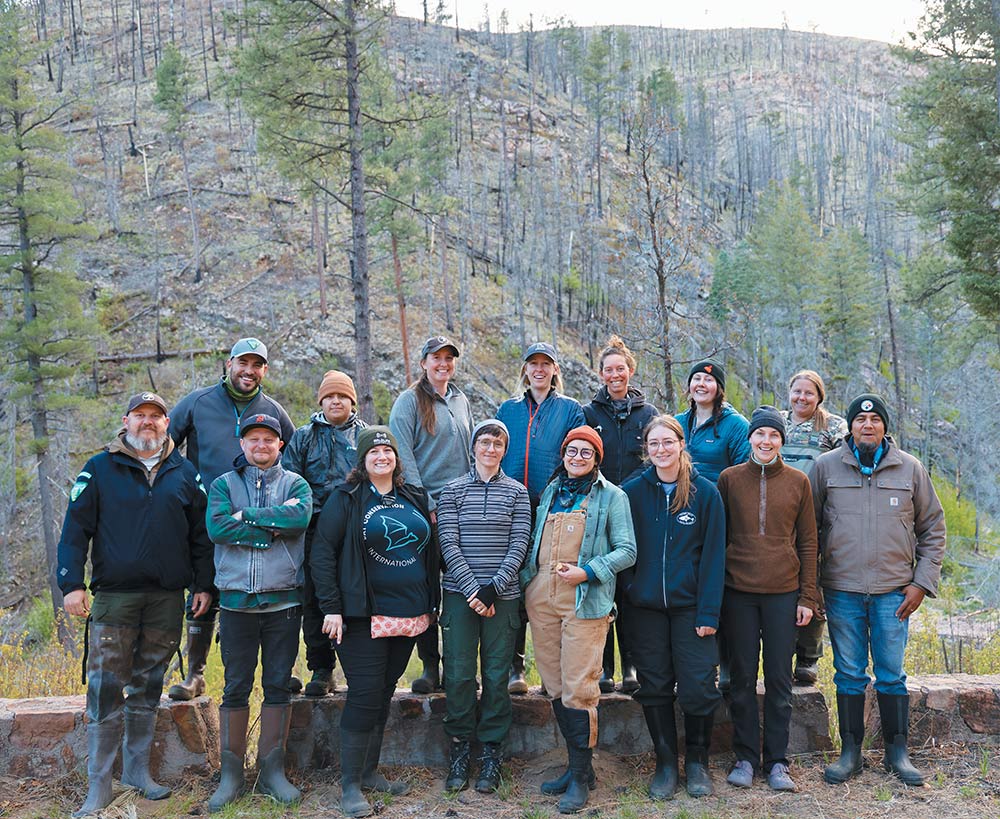
Group of researchers and conservationists posing outdoors in front of a wooded hillside.
Biologists from BCI, U.S. Forest Service, Bureau of Land Management, and New Mexico Game and Fish prepare to capture bats in Gallinas Canyon in the Santa Fe National Forest.
Photo: Rachel Harper
T

he wide beam of my spotlight illuminates a small, furry creature suspended in mid-air. The bat is caught in a fine net stretched over Gallinas Creek in the Sangre de Cristo mountains in northern New Mexico. As one of BCI’s biologists and trainers on the project, I guide a fellow scientist through the process of untangling the bat. First, we identify which side of the net it entered from. Then, we slowly work the fine strands off the bat’s back and over its elbows, wrists, and head.

It’s 8 p.m., and our work is just beginning. We are surrounded by the soothing sounds of the creek, the brilliance of the night sky, and great bat habitat. Looming in the distance is the bare-rock face of Hermit’s Peak, and a ponderosa pine forest surrounds us. Some trees are green while others are charred. This canyon was caught in the confluence of the Hermit’s Peak and Calf Canyon fires, which together in the spring of 2022 burned 340,000 acres, making it the largest recorded wildfire in New Mexico’s history.

Collaboration is critical for an effective response to such a widespread threat, and as part of this effort, BCI scientists trained Forest Service staff and partners on proper bat capture and handling techniques so they can continue monitoring.
To aid the recovery process, BCI is partnering with the U.S. Forest Service to restore damaged infrastructure and fencing in the Santa Fe National Forest, ensuring wildlife have access to water. In addition to restoring this critical habitat, the Forest Service wants to learn about the bats’ health, specifically whether white-nose syndrome (WNS) is present.

Bats infected with WNS tend to rouse during hibernation, burning precious fat reserves in the process. If this happens repeatedly, a bat can starve to death. The disease has steadily progressed westward, and in 2023, the fungus was first detected in New Mexico.

Small furry brown bat being held carefully by a gloved hand.
A long-legged myotis (Myotis volans) prepares to fly.
Photo: Jessie Bunkley
Monitoring for the pathogen on the landscape requires scientists to capture bats and swab their wings and noses. The swabs are then analyzed for the fungus’s DNA. Collaboration is critical for an effective response to such a widespread threat, and as part of this effort, BCI scientists trained Forest Service staff and partners on proper bat capture and handling techniques so they can continue monitoring. During this training, which took place over two weeks in April and May 2026, 20 wildlife professionals from six agencies learned to net, handle, and swab bats.

Capturing bats along Gallinas Creek is part of this effort. After carefully extricating the bat from the net, we take it to our tabletop lab, where we swab its nose and a forearm, take numerous anatomical measurements, and evaluate its health. Other biologists gather around, watching and learning. Together, we work our way through a key to determine the species: long-legged myotis (Myotis volans).

Soon, the bat is ready to return to the skies. This is everyone’s favorite moment: seeing the bat fly back to its wild home and disappear into the darkness of night.