plant iconFeature: India’s Bats

The State of India’s Bats

The State of India's Bats
Leisler’s bat (Nyctalus leisleri) is found in India.
Photo: Rohit Chakravarty Ph.D.
F

or decades, India’s bats have largely lived in the shadows. Not just at dusk when they emerge to forage, but also in terms of conservation awareness.

India is home to 135 species of bats, making it one of the world’s richest countries for bat diversity. The country’s bats pollinate flowers, disperse seeds, regenerate forests, and consume enormous numbers of agricultural pests. Yet despite their ecological importance, bats have rarely received the attention afforded to tigers, elephants, rhinos, or other species that fit in the category of “charismatic megafauna.”

That is one reason the new “State of India’s Bats” report represents such an important milestone.

Developed through a collaborative effort by researchers, conservationists, and institutions from across the country, the report is the first comprehensive assessment of India’s bats and the challenges they face. More than a status update, it serves as a roadmap for future research, conservation action, and public engagement.

The report was inspired by BCI’s 2023 “State of the Bats” assessment for North America and reflects a growing effort to create regional assessments that identify conservation priorities before species become imperiled.

“It’s critical to be able to act quickly when it comes to bat conservation,” says Isabella Mandl, Ph.D., BCI’s Regional Director for Africa and South Asia. “BCI’s ‘State of the Bats’ reports are meant to be important resources, highlighting conservation and research priorities and enabling stakeholders to prevent bat extinctions. The ‘State of India’s Bats’ report is the first of its kind to shine the spotlight on local bats and lays the foundation for collaborative action across the country.”

But the story behind the report is as significant as the findings themselves.

Five men stand in a row indoors holding copies of a report titled "State of India's Bats" featuring a bat cover photo.
Launch of the “State of India’s Bats” report at WWF-India, New Delhi.
Photo: NCF/BCI

Uniting a vast country

Creating a national assessment of India’s bats was no small undertaking. “India is a vast country with vast biodiversity, but fewer than 50 people are dedicated bat researchers,” says BCI’s India Program Manager Rohit Chakravarty, Ph.D.

Harish Prakash, Ph.D., is one of the report’s contributors, and he sees collaboration as one of its most important achievements.

“The common factor that brings us all together is expertise in bats,” Prakash says. “However, all of us have studied different species, asked different questions, and worked in different landscapes. Bringing all this experience and knowledge together through collaboration is the main highlight of this report.”

India is home to 135 known bat species.
One of the report’s most striking findings is how much remains unknown. While many wildlife assessments focus on population trends and long-term monitoring data, bat researchers in India often lack that luxury.

“Whenever we say the ‘state of’ something, it gives the impression that we’re going to put out numbers about population declines, but that’s not the case with this report simply because we haven’t had that long history of bat research in India,” Chakravarty says. “What we focused on in this report is building that knowledge base.”

A large colony of bats roosts on the ceiling of a dark cave while one bat flies through the air in the foreground.
A colony of leaf-nosed bats (Hipposideros sp.) in a cave.
Photo: Rajesh Puttaswamaiah
The result is a document that highlights not only what scientists know, but also what they do not know. Researchers still lack basic information about the distribution, population size, ecology, and threats facing many species. Some regions remain especially understudied. For example, Chakravarty says, “We haven’t quite scratched the surface of the bat diversity of the Himalayas.”

Far from being discouraging, those gaps reveal next steps. One of the most difficult tasks the team encountered while preparing the report was turning a long list of unanswered questions into a practical roadmap for future research and conservation.

“The challenge was identifying the priorities, and which areas were not the most pressing priorities in the next 10 years,” Chakravarty says.

The ‘State of India’s Bats’ report is the first of its kind to shine the spotlight on local bats and lays the foundation for collaborative action across the country.
—Isabella Mandl, Ph.D.

A country of extraordinary bat diversity

India’s bats occupy an astonishing range of habitats, from tropical islands and dry forests to cities, caves, agricultural landscapes, and the high Himalayas.

Some of the species highlighted in the report illustrate both the richness and fragility of that diversity. One is the Nicobar flying fox (Pteropus faunulus), a species found only in the Nicobar Islands. With development pressures increasing in parts of the archipelago, researchers worry about the future of this little-known bat. “There’s a big risk that the species will just vanish while we are being oblivious to its existence,” Chakravarty says.

Some species highlighted in the report are known as much for their absence as their presence. “A species called the Peters’s tube-nose bat (Harpiola grisea) in the Himalayas has not been seen for the last 150 years,” he says. “We need more studies just to be sure that the species still exists.”

India has fewer than 50 bat researchers.
Six bats cling vertically to a textured, teal-tinted cave wall, spaced out in a cluster against the rock surface.
Greater false vampire bats (Lyroderma lyra) roosting in an old temple.
Photo: Rohit Chakravarty
The report also highlights numerous Threatened species whose futures remain uncertain because so little information exists about them. But the project’s scope extends beyond documenting species already at risk. “The spirit in which the ‘State of India’s Bats’ report was made was that not only do we focus on the Endangered species, but we also focus on the common species to prevent them from becoming Endangered in the future,” Chakravarty says.

Bats face many of the same threats affecting wildlife worldwide, including habitat loss, disturbance of roosting sites, urban expansion, and a changing climate. But researchers say negative public perception remains one of the most persistent obstacles to conservation. This was highlighted further during the COVID-19 pandemic.

“The seeds of this were sown during COVID, because that was a time when bat researchers all across the world had to come together,” Chakravarty says. “There was such a high level of misinformation that we had to tackle.” Researchers responded by increasing public outreach and correcting misconceptions.

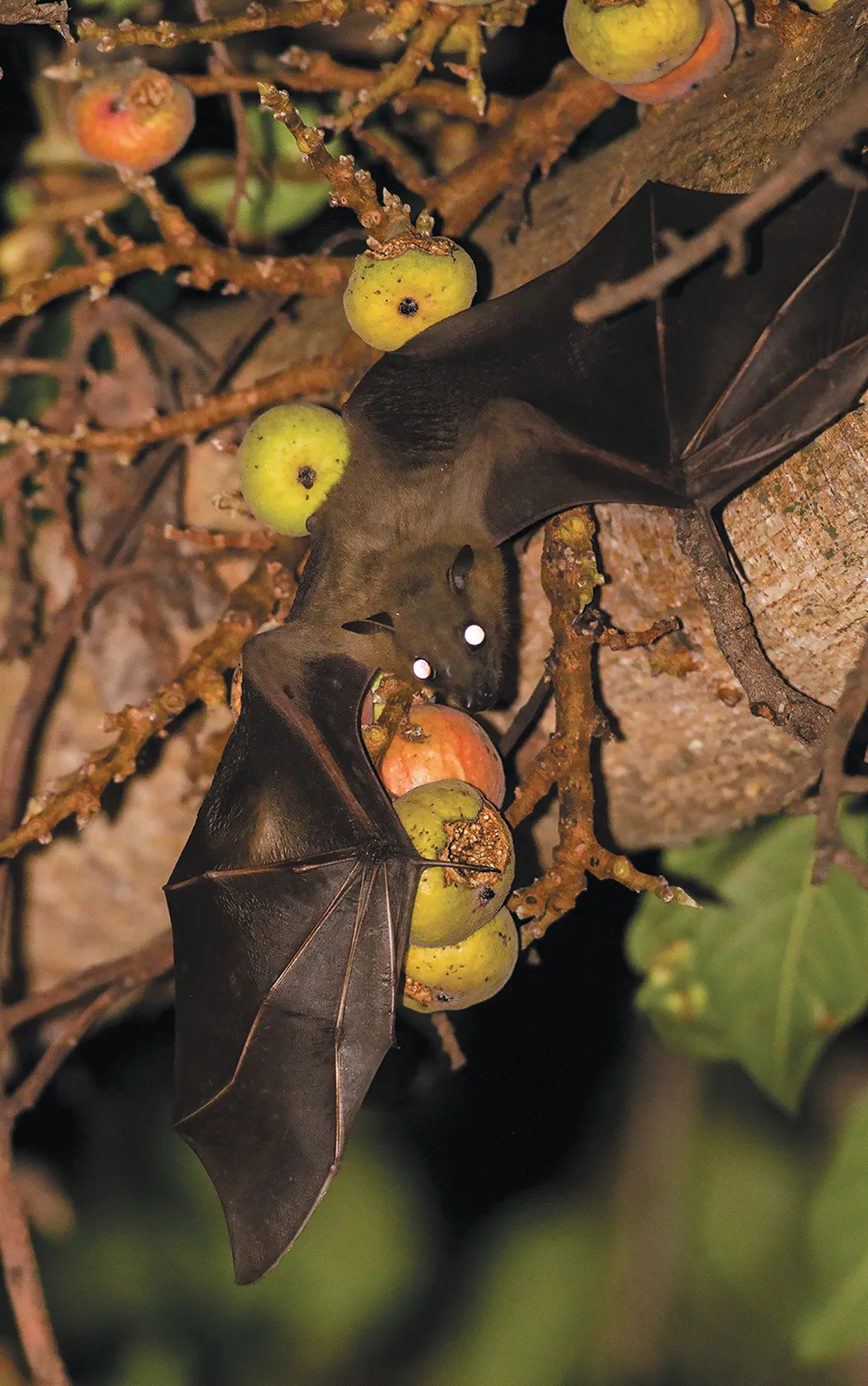
A dark fruit bat with glowing eyes hangs upside down in a tree, clinging to branches surrounded by round figs.
Greater short-nosed fruit bat (Cynopterus sphinx).
Photo: Rajesh Puttaswamaiah

Conservation solutions already exist

While the report identifies serious threats, it also points toward practical solutions.

One promising area involves protecting bat roosts in historic monuments. “Natural caves have been destroyed in many areas, so these monuments have become bat habitats,” Chakravarty says. Yet protection can be complicated. “The bat lives in a protected habitat, but the bat itself is not protected,” he says.

Beyond site protection, the report calls for expanded monitoring, stronger policy support, habitat restoration, and greater public awareness. Prakash hopes future efforts will identify local threats more clearly. “We are lacking in our understanding of all the threats bat species face locally and how it is impacting their population,” he says. “In the next couple of years, I hope we identify such critical threats and work toward mitigating them.”

Ultimately, the report argues that bat conservation is about far more than protecting individual species. As Chakravarty puts it, “Bat conservation is not just a forest department problem or an environment ministry problem. It’s a problem that touches upon and intersects with a lot of human-centered topics like pest control and diseases. Therefore, bat conservation should also be a priority of other government bodies.”

Those connections extend well beyond ecology. “Bat conservation is not a problem of just environmental conservation,” Chakravarty adds. “It links to human health, it links to human economics, it links to human societies, and with that recognition, all of us have a role to play.”


One of the biggest intangible outcomes of this report is that we now have a large group of people who are willing to collaborate with each other and advance the state of bat conservation in India.
—Rohit Chakravarty, Ph.D.
The report’s authors hope it will serve as a starting point rather than a final word.

Prakash envisions the contributors reconvening in five or 10 years to evaluate progress, ideally joined by a new generation of researchers. Chakravarty believes one of the report’s greatest achievements may be the community it helped create.

“One of the biggest intangible outcomes of this report is that we now have a large group of people who are willing to collaborate with each other and advance the state of bat conservation in India,” Chakravarty says.

For a country with extraordinary bat diversity and enormous unanswered questions, that may prove just as valuable as the report itself.