Bat Squad For the young conservationist

Unlikely Allies

Conserving habitat benefits bats, frogs, other species
By Lindsay Lee Wallace
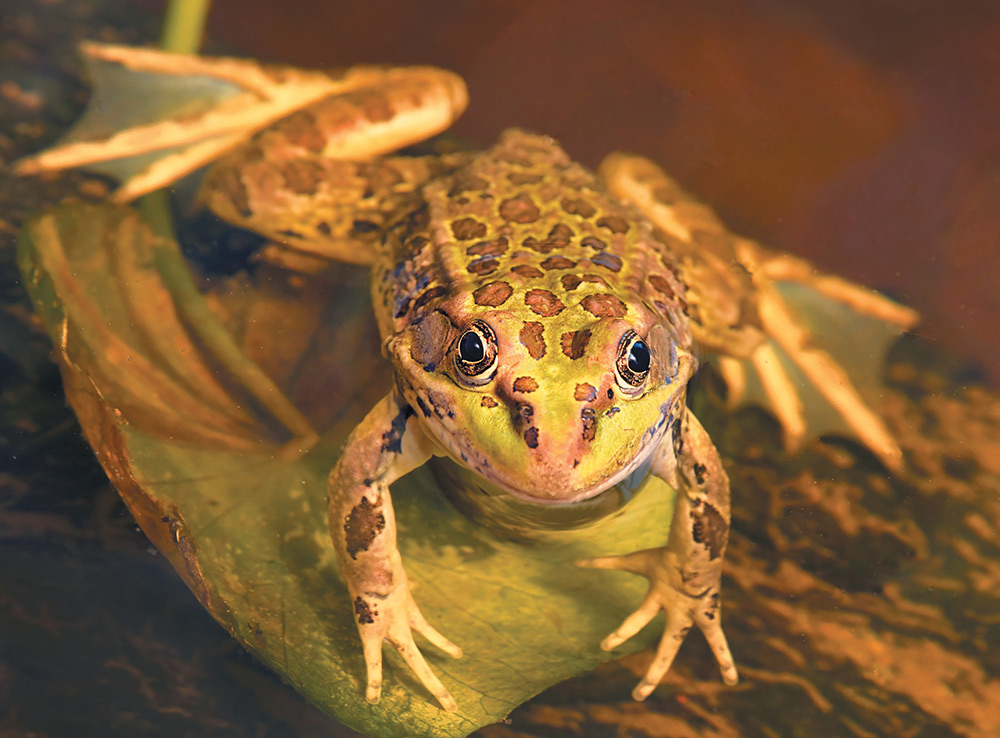
Close-up of a spotted green frog resting on a leaf in water.
A Chiricahua leopard frog (Rana chiricahuensis).
Photo: George Andrejko
S

cientists and conservation partners in the southwestern U.S. are working to forge an alliance between two unlikely creatures: bats and frogs.

The region supports the greatest diversity of bat species in the country, including species like the Mexican free-tailed bat (Tadarida brasiliensis), spotted bat (Euderma maculatum), pallid bat (Antrozous pallidus), and many others. It’s also the home of other unique animals, including the Chiricahua leopard frog (Rana chiricahuensis), which is classified as a Threatened species.

Long-eared bat with fully outstretched translucent wings
Spotted bats (Euderma maculatum) are one of the bat species that are particularly dependent on livestock and wildlife ponds for drinking.
Photo:Michael Durham/Minden Pictures
The Chiricahua leopard frog population faces a number of threats, including predation by invasive bullfrogs and mortality from a fungus-caused disease known as chytridiomycosis that has killed significant proportions of many amphibian species worldwide.

Where do bats and frogs come together?

According to Dan Taylor, BCI’s Senior Restoration Specialist, the most limiting factor for bats in this region is access to water. Not only do the various bat species that live in or visit the area need the water to drink, they also forage in the ecologically rich riparian zones that often surround bodies of water. Plentiful water sources are also essential to the survival of the Chiricahua leopard frog.

Because of the extent of natural habitat loss, these livestock ponds serve as critical water sources that are absolutely essential for maintaining bat and frog populations.
—Dan Taylor
Two mottled green frogs sitting inside a clear plastic container with water.
Chiricahua leopard frogs being released from Phoenix Zoo.
Photo: Cody Mosley
But over the last 100 years, the availability of naturally occurring sources of surface water like ponds, streams, and springs has greatly diminished. Taylor says this is due to agriculture, groundwater pumping, and a changing climate.

When bats want to drink water, they don’t stop flying. Instead, they dip low over a body of water and sip on the go. Even smaller bat species need a body of water that’s at least eight feet long, and larger species need up to 40 feet to perform this essential aerial maneuver.

Taylor and his team with BCI’s Habitat Protection and Restoration Program work to help the ecosystems that bats call home survive and thrive. A key part of this effort is restoring existing water sources. The team also works to create new water sources, like tanks and troughs that provide water for both wildlife and livestock.

Since natural water sources are disappearing, the remaining waters attract high numbers of bats and frogs.

“Because of the extent of natural habitat loss, these livestock ponds serve as critical water sources that are absolutely essential for maintaining bat and frog populations,” Taylor says.