
Species Study
There are 1,400+ species of bats in the world. This is one of them.
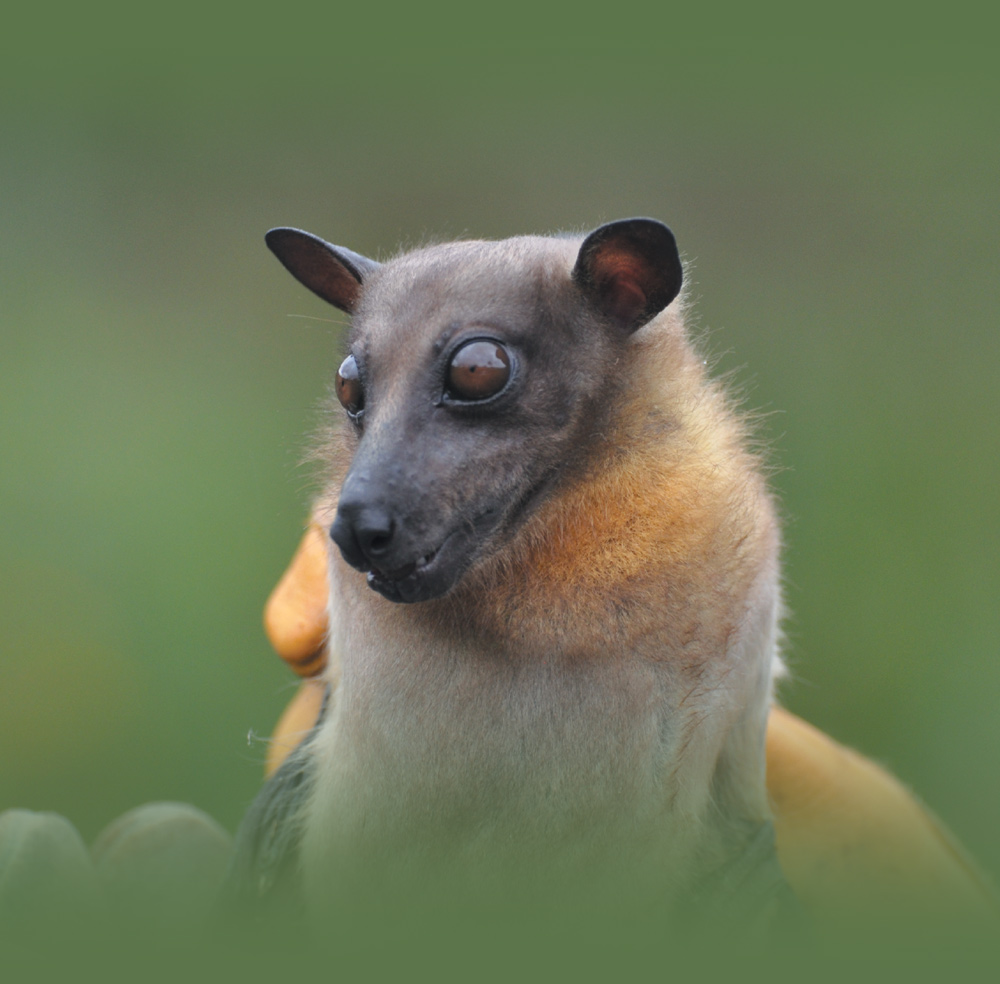
Close-up of a spectacled flying fox with dark gray and orange-brown fur.

Straw-colored Fruit Bat

Research network comes together to keep tabs on African species
By Michelle Z. Donahue
bat stats
Bat icon
Binomial

Eidolon helvum
Two bats icon
Family

Pteropodidae
Bat Globe icon
Colony Size

Tens to hundreds of thousands to millions

Scale icon
Weight

Up to 10 ounces (350g)
Leaf icon
Diet

Fruit, pollen, nectar
Exclamation Point icon
Status

Near Threatened
Region

Central to southern Africa; Senegal to Ethiopia and southeast to South Africa; limited populations along Red Sea coast of Yemen and Saudi Arabia
Stylized map of Africa, Europe, and the Middle East in black on a yellow background.
Photo: Paul Webala, Ph.D.
W

hile home gardens are often awash in colorful flowers and foliage, the walls of Glenys Shone’s garden in Ndola, Zambia, are painted with bats. Green stylized silhouettes of bats in flight and a roosting bat with a mouthful of fruit are displayed against a bright yellow backdrop.

The art is paired with cheerful hand-painted text imploring passers-by to not disturb the large group of straw-colored fruit bats (Eidolon helvum) roosting in the garden from September to January. “We disperse seeds from the fruit we eat so more trees can grow,” reads one placard. “Trees are essential to the environment, and so are we.”

Created with help from local schoolchildren, Shone’s murals adorn one site in a 13-country network across Africa that monitors and tracks straw-colored fruit bats. Although seasonal colonies can number in the tens to hundreds of thousands, the bats were once known to number in the millions. A persistent decline in numbers led the International Union for Conservation of Nature (IUCN) to upgrade the species from Least Concern in 2004 to Near Threatened in 2008, despite actual numbers remaining unknown.

A fearful decline

Strong fliers that can cover upwards of 55 miles in a night, straw-colored fruit bats play a vital role in pollination and forest tree seed dispersal across Africa.

However, the species faces many threats. Common across lowland forests and savannas from Senegal in the west, down to South Africa, and to Ethiopia in the east, Africa’s second-largest fruit bat is often hunted for meat. Deforestation and persecution due to unfounded fears of disease—exacerbated by COVID—have also amplified population declines. Because they are chatty, conspicuous, and smelly when gathered, people shoot at them, burn tires below roosts to smoke them out, or even cut down large roost trees.

“What you can observe in some of these city roosts, that once the big place that they use is gone, the big group [of bats] splits into smaller groups,” says Natalie Weber, BCI’s Strategic Advisor for Endangered Species Africa. “We don’t know yet how the loss of the large roost sites will impact them.”

Creating a monitoring network

The idea of establishing a monitoring network to better understand the bats’ seasonal movements originated in 2007 with Max Planck Institute (MPI) researchers Dina Dechmann, Ph.D., and Jakob Fahr, Ph.D., who were studying large colonies in Zambia’s Kasanka National Park and in Accra, Ghana.

To the human eye, 10,000 bats might seem like a million, but there was no practical, consistent way of counting them to determine year-over-year fluctuations. Dechmann and Fahr developed a standardized method to be able to quantify roost sizes, along with Weber and Teague O’Mara, Ph.D., who was then a postdoctoral student in Dechmann’s lab and is now BCI’s Director of Conservation Evidence.

In 2008, the Accra colony was estimated at around one million bats but had declined to just 100,000 only two years later. Alarmed, the researchers enlisted partners and communities who could keep tabs on straw-colored fruit bats in other parts of the continent using the same counting methodology.

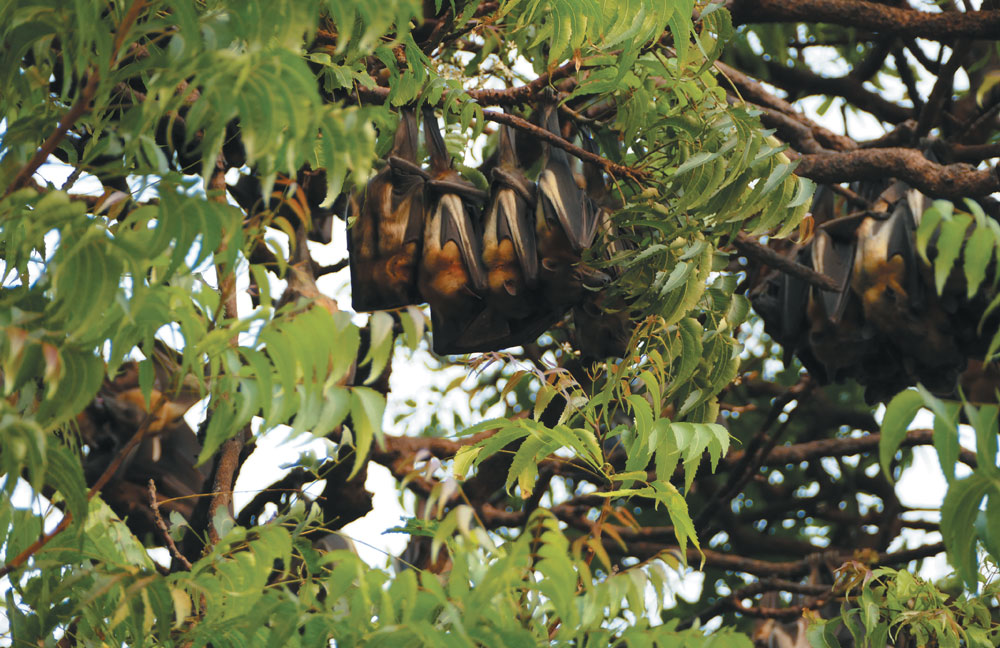
Bats hanging from a tree among green leaves.
Straw-colored fruit bats rest in trees.
Photo: Natalie Weber
The monitoring network—which was originally coordinated by MPI until 2015 and revived by Weber in 2020—has been hosted by BCI since January 2025 and includes partners in 13 countries. Collaborators range from individuals to nongovernmental organizations (NGOs).

“We had people who said, ‘I have these bats around me—sometimes they’re there, sometimes not,’” Weber says. “They got interested and started counting.”

The community monitoring network serves several important functions, including as a source of data for species studies.

In 2022, O’Mara and Weber co-authored a study using GPS tracking and network data demonstrating how straw-colored fruit bat migrations track closely to a “green wave” of seasonally available foods through its range countries. In Kasanka National Park, for instance, enormous seasonal groups are drawn by ripening bursts of sugar plum fruits.

“We suspect the seasonal migration timing works better when the roosts are larger,” Weber says. “So we’re trying to understand what happens after a major roost site is gone, when the groups are split up into smaller groups.”

The monitoring network is also a powerful tool for building community awareness. “Because the partners are going back to the same places every month or year to count the bats, they’re always talking to the people who pass by,” Weber says. “You can change a lot of people’s minds just from being interested in these animals.”

leaf icon
Straw-colored fruit bats are strong fliers that can cover upwards of 55 miles in a night. They play a vital role in pollination and forest tree seed dispersal across Africa.
Network efforts have also supported international legal protections. At the 2024 Convention on Migratory Species of Wild Animals (CMS) meeting in Uzbekistan, straw-colored fruit bats were recognized as a protected migratory species in need of a Concerted Action with support from five of the monitoring countries.

“Bit by bit, we are trying in each country to make authorities aware that the species is there,” Weber says. “We can have a peaceful coexistence with our animals, and the solutions are simple—but there has to be the willingness to do it.”