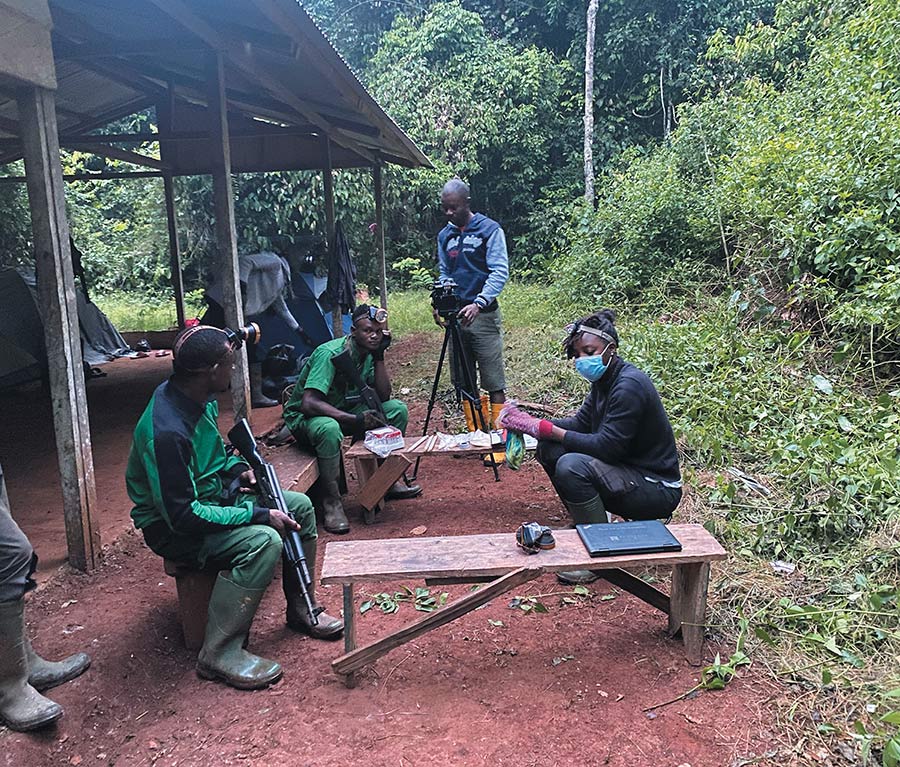
Deep in the lowland forest of her native Cameroon, BCI Student Scholar and doctoral student Aïcha Gomeh-Djame is breaking new ground as the first person to study bats in Lobéké National Park. The park is part of a biologically rich transborder UNESCO World Heritage Site that also includes protected areas in the Republic of Congo and the Central African Republic.
Data on bats in Lobéké were virtually nonexistent prior to Gomeh-Djame’s research, which involved catching about 350 bats in Lobéké that represented a potential 36 different species. She also succeeded in making the first recordings of bat echolocation in the park. “The primary aim of the project was to quantify the impact of roads on the bat diversity, relative abundance, and functional guilds of bats in Lobéké National Park,” she says.
Data analysis is ongoing, but Gomeh-Djame has found that bat diversity is highest in the Forest Management Unit Buffer Zone, not far from the forest entrance. This area has pockets of disturbed areas created by logging activities, with roads and degraded habitats. The lowest diversity was found in the Intact Forest Core Zone. While analyzing the data and genetic samples, Gombeh-Djame also realized that she had discovered a potential new species. While she is not yet ready to reveal details, she says it is in the family Vespertilionidae.
Gomeh-Djame has also provided training and education to national park staff and the local Baka people to improve their understanding of bats and their importance to regional ecosystems. The communities in and around the park largely consist of people who rely on forest resources through semi-nomadic hunting and gathering. They had many negative misconceptions about bats, but these attitudes began to change when Gomeh-Djame introduced them to some of the species she captured.
“I was so happy when someone told me, ‘Oh, this bat is cute,’” she says.
The funding from BCI’s Student Scholarship program has provided crucial support for Gomeh-Djame’s work, which involves two days of expensive travel from her home to her field sites, as well as additional costs for logistics, genetic analysis, equipment, and other essentials. Gomeh-Djame was also part of the Cameroon cohort that participated in the recent MENTOR-Bat program alongside bat researchers from Colombia and Indonesia, as well as BCI staff.