field notes

Global Scholarship

BCI welcomes newest cohort of Student Scholars
By Jill Robbins
A female researcher, wearing a bandana and long-sleeved shirt, attaches a small device to a tree in a natural landscape at dusk.
BCI 2024 Student Scholar Angélica Viviana Yantén Arévalo installs an acoustic recorder in Brazil.
Photo: Marcelo Martins
S

ince it began in 1989, Bat Conservation International’s (BCI) Student Scholarship program has supported the work of 417 researchers working on projects across 80 countries. BCI recently welcomed its 2025 cohort of Student Scholars, with 14 graduate students representing 10 different countries, including the first-ever BCI Student Scholars from Burkina Faso and Kosovo.

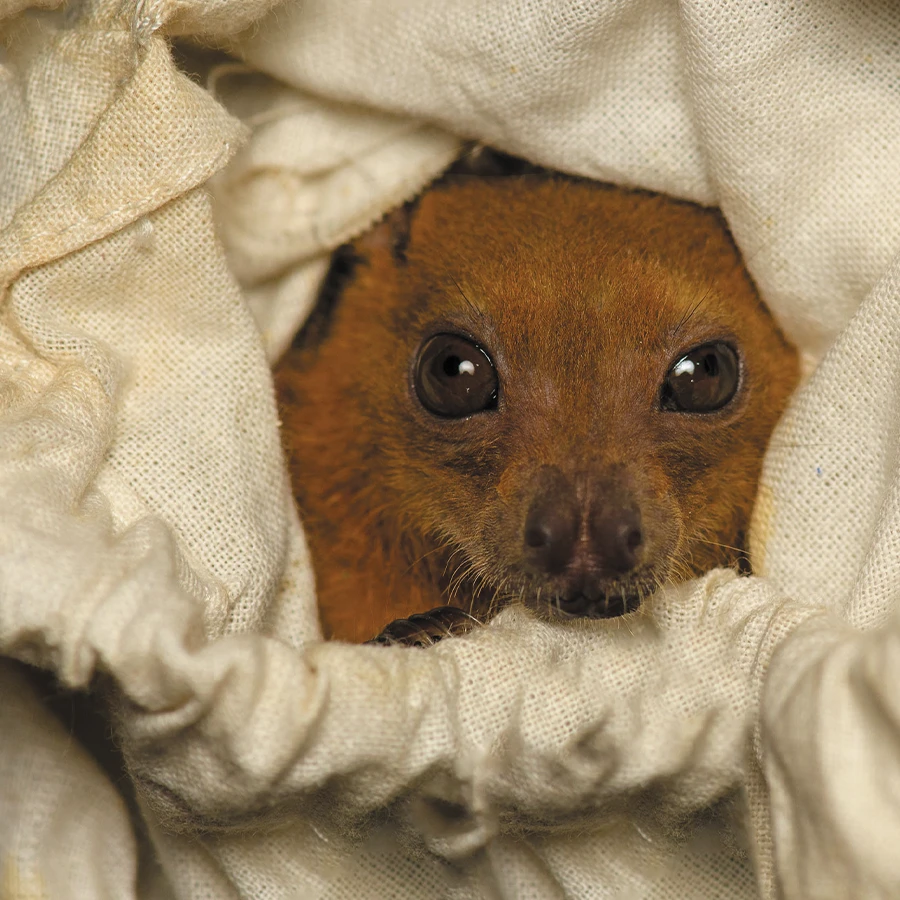
A greater short-nosed fruit bat peeking out of a bag.
A greater short-nosed fruit bat (Cynopterus sphinx) peeks out of a bag at 2024 Student Scholar Nithin Divakar’s study site in India.
Photo: Nithin Divakar
This annual scholarship program allows BCI to provide financial support and professional development to emerging scientists. The application process includes a proposal addressing multiple bat conservation challenges, including the impact of human-caused environmental changes. Scholars must submit their projects to BCI for approval and are encouraged to share their findings with local communities.

One of the Student Scholar Program’s biggest benefits is that it opens up the world to participants. Scholars are connected to a larger community of bat researchers for greater collaboration, knowledge-sharing, and creative problem-solving.

“The ultimate goal [of fostering these connections] is conserving bat species around the world,” explains Ellie Opdahl, BCI’s Science Department Coordinator. “We are grateful to support such a diverse portfolio of conservation research.”

In 2024, BCI hosted the first-ever Cohort-to-Cohort Virtual Conference, which allowed the newest cohort to interact with program alumni.


“As the student scholar community grows, we continuously look for ways to make the program more impactful,” Opdahl says. “We hope to increase the number of professional development opportunities through mini-workshops, panel discussions, and other mentorship programs with BCI staff.”

Nithin Divaker, a 2024 Student Scholar, is currently working on developing long-term bat conservation in the Indian state of Kerala. Divaker describes the program’s networking opportunities as invaluable. “Networking with bat researchers from around the world directly contributed to the growth of my academic and conservation capabilities,” Divaker says.

Aicha Gomeh-Djame, one of BCI’s 2024 Student Scholars and current Ph.D. candidate at the University of Yaoundé I, Cameroon, finds a lot of value in the program.

book icon
Since it began in 1989, Bat Conservation International’s (BCI) Student Scholarship program has supported the work of 417 researchers working on projects in 80 different countries.
“At a personal and professional level, this opportunity gave me more confidence in myself and also gave me the strength to work hard,” Gomeh-Djame says.

Gomeh-Djame is currently wrapping up fieldwork on the diversity, distribution, ecology, and conservation status of Congolian lowland forest bats in Cameroon’s Lobéké National Park, part of Sangha Trinational, a transboundary UNESCO World Heritage Site. Once she completes her Ph.D., Gomeh-Djame looks forward to researching biodiversity challenges in West and Central Africa.

The ultimate goal [of fostering these connections] is conserving bat species around the world. We are grateful to support such a diverse portfolio of conservation research.
—Ellie Opdahl
BCI’s Director of Research Coordination Amanda M. Adams, Ph.D., is inspired by the dedication and drive she sees in each Student Scholar.

“BCI’s Student Scholars impress me with their passionate dedication to an often misunderstood and vital taxa,” Adams says. “Their commitment to community outreach and education signifies a powerful drive to translate complex science into tangible conservation action, inspiring future generations. They are our next generation of bat conservationists.”