Field notes Research news from around the globe
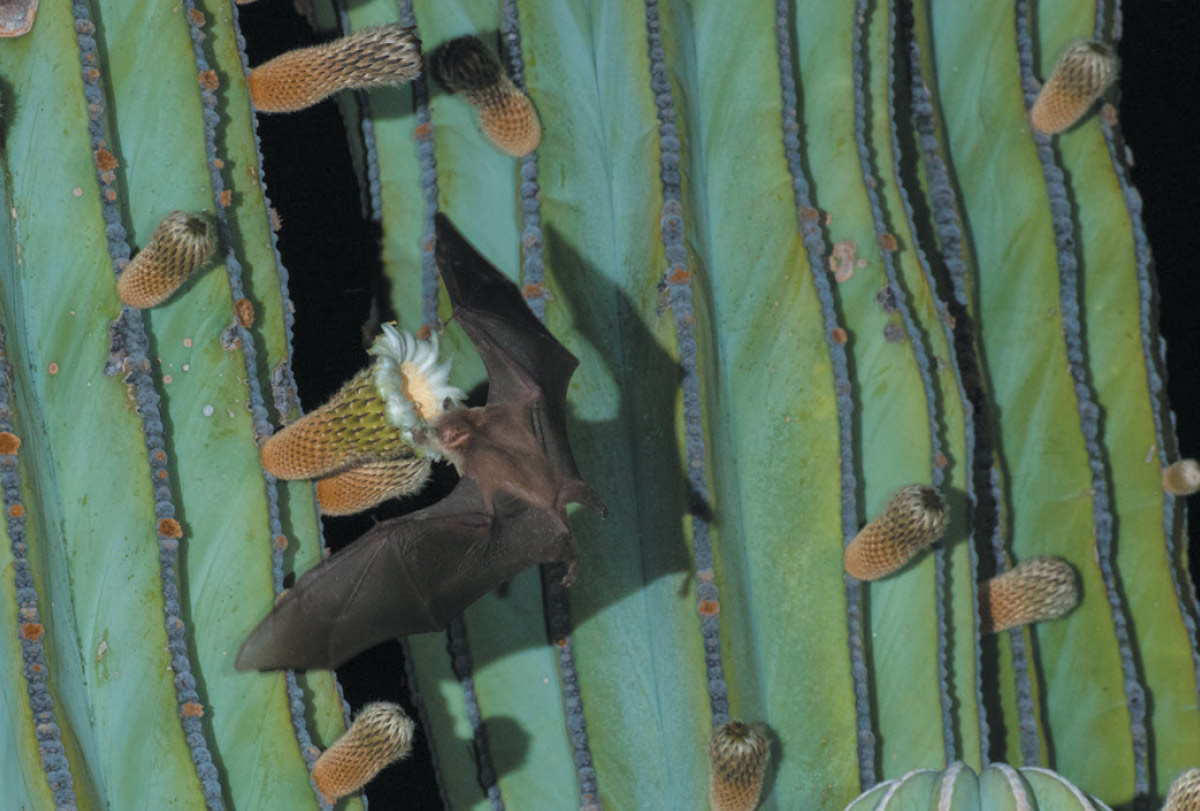
A lesser long-nosed bat (Leptonycteris yerbabuenae) visits a flower to feed.
Photo: Bruce D. Taubert

Long-Distance Flyer

Study reveals lesser long-nosed bats fly great distances—even across open water
By Annika Hipple
A

lesser long-nosed bat (Leptonycteris yerbabuenae) can weigh less than an ounce, but researchers found these tiny bats can fly vast distances–with one bat flying 117 miles in a single night. To learn more about these migratory pollinating bats and their journey following flowering resources across the Sonoran Desert, scientists from Bat Conservation International (BCI) collaborated with a binational research team to study them.

A surprising find

In 2013, BCI Chief Scientist Winifred Frick, Ph.D., installed passive integrated transponder (PIT) tag readers—the same technology used to microchip pets—at two known lesser long-nosed bat roosts in the Mexican state of Baja California Sur on the Baja California Peninsula. Frick and other researchers wanted to understand how bats on the Baja Peninsula—which is surrounded by water—are connected to other parts of the range.
microscope icon
Bat researchers are using passive integrated transponder (PIT) tags to track bats. This is the same type of microchip veterinarians use to reunite lost pets with their families.
scientists working on project together at table outdoors
BCI Chief Scientist Winifred Frick, Ph.D., and past BCI Student Scholar Veronica Zamora, Ph.D., work with colleagues in Jalisco, Mexico.
Photo: Winifred Frick, Ph.D.
These readers identified and logged each time a tagged bat entered or exited the roost cave. Although Frick began seeing movement between the two sites on the Baja Peninsula, she had no way of knowing how much farther the bats were traveling until another researcher installed a PIT tag reader at a site in Arizona seven years later.

“In September of 2020, researchers in Arizona detected a tag they didn’t recognize, and it was one of my bats,” Frick says. “That was the first long-distance movement of a bat that had been tagged in Baja being detected in Arizona.”

Mind-boggling migration

The discovery prompted researchers to install additional scanners at other key roosts in both the Southwestern U.S. and Mexico. Soon, tagged bats were showing up all over the map. More than 4,000 bats have been tagged, and readers are now positioned at the entrances to 12 known roosts.

“We were able to confirm individual bat movements as far as 1,000 miles,” says Theresa Laverty, Ph.D., the lead author of the study and Assistant Professor in the Department of Fish, Wildlife, and Conservation Ecology at New Mexico State University. “Not only can they fly really far at times, but flying across the sea means there’s no food below you and no areas to stop along the way.”

“We’re able to demonstrate that multiple individuals are moving these long distances between different cave roosts.”
—Winifred Frick, ph.d.
One bat flew 117 miles overnight across the Gulf of California, from the Baja Peninsula to Sonora, Mexico. The next day, it flew back to its roost on the Baja Peninsula.

“Migration is an important natural process for all animals, human or not,” says Rodrigo Medellín, Ph.D., Professor at the National Autonomous University of Mexico and one of the study’s authors. “The ability of a small bat that weighs around an ounce being able to migrate at least 2.3 million times its own body length is nothing short of mind-boggling.”

Frick says that is one of the team’s most exciting findings to date, in addition to the scope of connectivity of the populations. “We’re able to demonstrate that multiple individuals are moving these long distances between the different roost sites,” she says.


clipboard icon
The study found one lesser long-nosed bat flew 117 miles overnight across the Gulf of California, from the Baja Peninsula to Sonora, Mexico. The next day, it flew all the way back to Baja.
A lesser long-nosed bat feeding on nectar
A lesser long-nosed bat feeds on the nectar of a cardon cactus along its migratory route in northwestern Mexico.
Photo: Richard Jackson
These findings highlight the importance of conserving roost sites and foraging habitat, as well as the need for binational cooperation to protect food sources for bats migrating across the U.S.–Mexico border.

“The lesser long-nosed bat feeds on nectar and fruits of plants, primarily columnar cacti and agave, so one key conservation implication is trying to manage the landscape in a way that promotes food for bats, particularly at times of the year when we think bats will be there,” Laverty says.

As researchers continue to collect and analyze data, we will learn more about the comings and goings of these incredible bats, and conservationists will be able to take action to protect these bats and their food resources and habitat.