

 Feature: Wind Turbines
Making the Sky Safer for Bats
hen BCI Research Scientist CJ Campbell, Ph.D., first set out to study bat migration during her graduate program, she thought she knew what she’d find. After all, you don’t have to be a scientist to understand the basics of typical seasonal migration: as temperatures drop, people and animals alike tend to head toward warmer climates.
But a paper that Campbell and colleagues recently published suggests that winter migration is far more complicated for certain bat species. They found that two of the three bat species most affected by wind turbine collisions—the hoary bat (Lasiurus cinereus) and Eastern red bat (Lasiurus borealis)—don’t follow this typical pattern.
Together, the hoary bat, Eastern red bat, and silver-haired bat (Lasionycteris noctivagans) represent about 75% of fatal bat collisions with wind turbines in the U.S. Hoary bats make up about one-third of these collisions and are of particular concern. In 2017, BCI Chief Scientist Winifred Frick, Ph.D., published a paper with colleagues demonstrating that current wind energy fatality rates could reduce the population of the hoary bat by as much as 90% over 50 years.
Most fatalities occur during late July and August, during the autumn migratory period. However, little is known about bat movement patterns during that time of year.
“That is really important, because we want more green energy, and we want it to be wildlife-friendly,” Campbell says.
Determining migration through bat fur
Conducting that research was more difficult than it sounds. “Bat migration, particularly over long distances, is incredibly hard to study,” Campbell explains. Bats are challenging to catch, and even if you do catch them, they’re too small for most GPS transmitters that might be deployed for tracking larger animals. “In most circumstances, we know almost nothing about long-distance bat migration, so we have to get very creative in the methods we use to study it,” Campbell says.
—CJ Campbell, Ph.D.

Photo: J. Scott Altenbach
This technique uses predictable variations in the weight of hydrogen found in rainwater to tell scientists where a raindrop fell. “When looking at the isotopes, the rainwater in Florida is going to look very different from the water in New England,” Campbell says. As bats drink and forage in their local environments, the “isotopic signature” of local rainwater is incorporated into their fur.
Throughout their migratory journeys, “you are what you eat, in a very literal way,” says Campbell. By analyzing the fur of thousands of individual bats, she and her team forensically reconstructed the previous movements of those individuals.
A curious revelation
The team expected to find “to-and-fro migration,” which Campbell says is when bats “spend the summer somewhere in northern areas, then fly south in the fall and overwinter somewhere balmier, and then fly back north in the spring.” She describes this migratory pattern as “the default we expect to see in most seasonal migrations,” like with most songbirds.
However, she found that hoary bats and Eastern red bats weren’t following this typical pattern. Instead, their migration pattern was far more complex and unexpected. When Campbell was analyzing the results, she repeatedly reviewed the data and results, but the signal remained atypical from what she would have expected from seasonal bird migrations. These bats were flying in long, wandering routes in the autumn, sometimes traveling hundreds of kilometers northward from their summer homes before eventually traveling back southward to warmer areas to overwinter.
Dark Skies for Bats—and Humans
Like a motion-detection light in front of your garage, wind turbines can be equipped with aircraft detection lighting systems that protect bat lives by automatically turning off their flashing lights when the sky overhead is empty. Migratory bats use vision when navigating across long distances and might be attracted to the flashing lights.
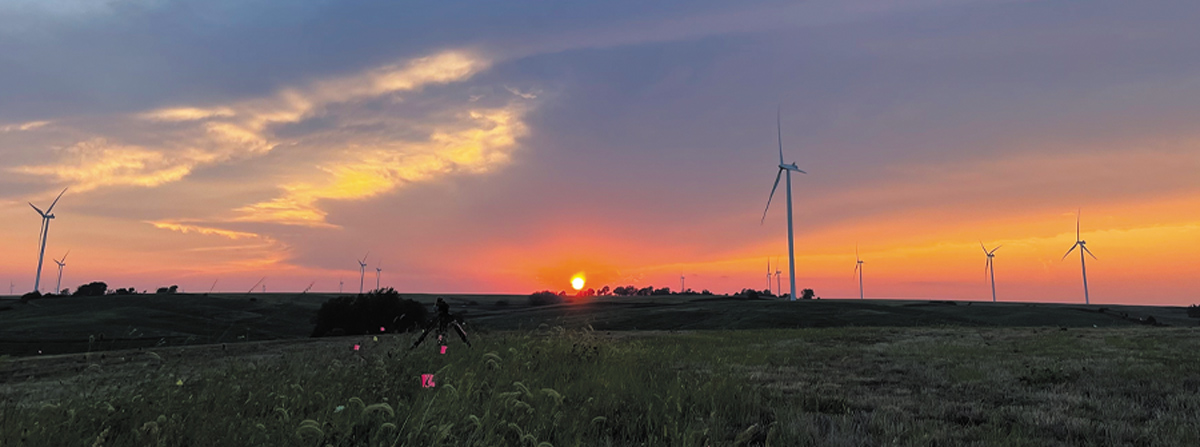
BCI is working to learn more about how to reduce fatal bat collisions with wind turbines.
Photo: Brian Anschel
He goes on to say that the strategy aligns with existing dark skies initiatives, which aim at reducing the amount of artificial light in remote places to promote animal welfare and human enjoyment of the night.
“Dark skies initiatives are popular,” Whitby says. “And the aircraft detection lighting systems on wind farms are in high demand in areas where wind farms are expanding. We think it might have real promise to also substantially reduce bat fatalities.”
Research was scheduled to begin in 2025 but has been delayed by the Department of Energy. Additionally, research conducted in Germany and published in October 2025 shows that minimizing aviation lighting reduces the activity of some bats near turbines.
International Collaboration on Bats and Wind Energy
International Union for Conservation of Nature (IUCN) is a global organization with a mission to unite the world’s leading conservation experts from public, private, and nongovernmental organizations with the goal of ensuring that human progress and the protection of nature happen in tandem.
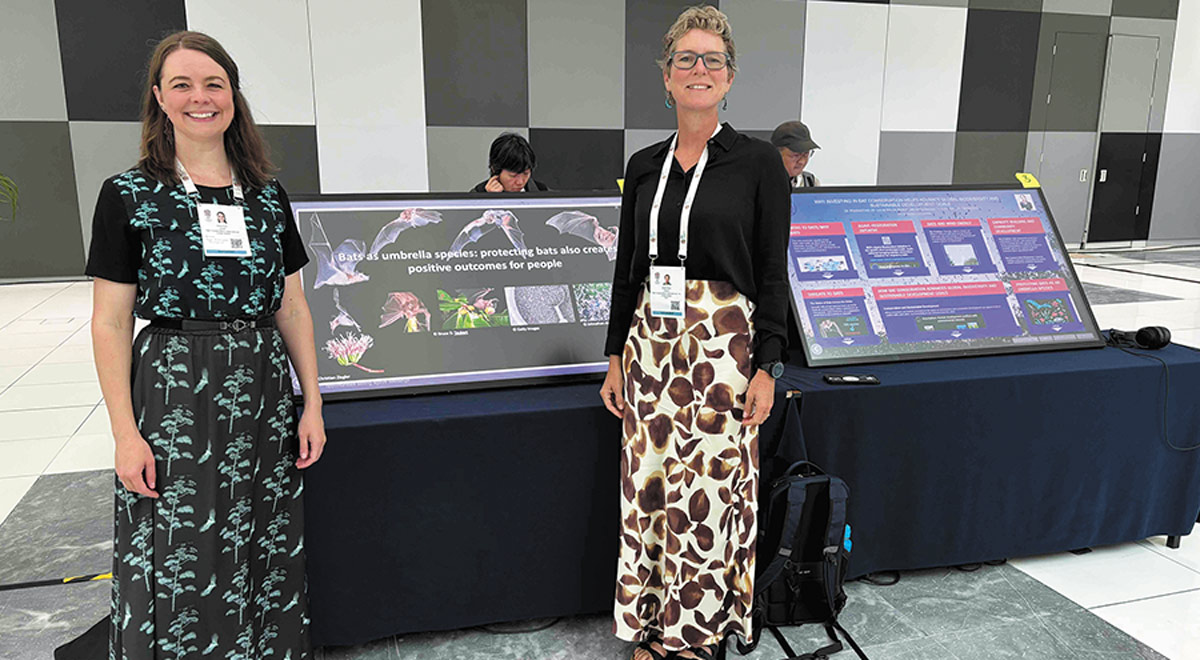
BCI presented a poster at IUCN WCC about bat conservation, including how reducing bat fatalities at wind farms contributes to global sustainability goals. Pictured are Agave Restoration Program Director Kristen Lear, Ph.D., and Chief Scientist Winifred Frick, Ph.D.
Photo: BCI
The motion was crafted by BCI and cosponsored by 13 other IUCN member organizations, and was developed as part of BCI’s collaboration with the Energy Task Force of the United Nations Convention on the Conservation of Migratory Species of Wild Animals. BCI’s Chief Scientist Winifred Frick, Ph.D., chairs the Bat Mitigation Working Group of the Energy Task Force, which works on raising awareness and informing global policy to protect migratory bats as renewable energy infrastructure expands globally.
The IUCN motion sounds the alarm about the millions of bats that are killed globally in collisions with wind turbines every year. It informs policymakers on the effectiveness of curtailment and other strategies to reduce bat fatalities and encourages energy companies and regulatory bodies to adopt proven best practices to reduce bat fatalities through effective mitigation planning for wind energy facilities.
How understanding migration can protect bats
The more we know about where and when bats are migrating, the more precisely wind turbine curtailment strategies can be deployed to avoid bat fatalities and energy loss.

However, when research can demonstrate best practices with implementable solutions, it becomes easier to influence policy and advocate for wind facilities to adopt those practices.
Campbell emphasizes that expanding renewable energy capacity through wind energy development could have a positive impact on bat conservation since reducing climate change caused by fossil fuels benefits all living things, including bats. But it’s crucial to ensure that wind facilities are constructed and operated to minimize their impacts on wildlife.
“Bats are at risk everywhere,” Campbell says. “We are really concerned about the magnitude of bat fatalities and are urgently looking for solutions to better place and operate facilities to be as friendly to bats as possible.”