


B
ridges across the U.S. can host massive colonies of Mexican free-tailed bats (Tadarida brasiliensis), yet monitoring these roosts is a daunting task. With thousands of bridges and limited resources, it’s impossible to survey every structure. To address this, BCI, in collaboration with Montana State University and the North American Bat Monitoring Program (NABat), developed an open-access predictive tool to identify which bridges are less likely to host bats so managers can focus their surveys on bridges that matter most. We asked BCI’s Director of One Health, Luz de Wit, Ph.D., about this tool.

Read the findings in Global Ecology and Conservation: doi.org/10.1016/j.gecco.2025.e03551
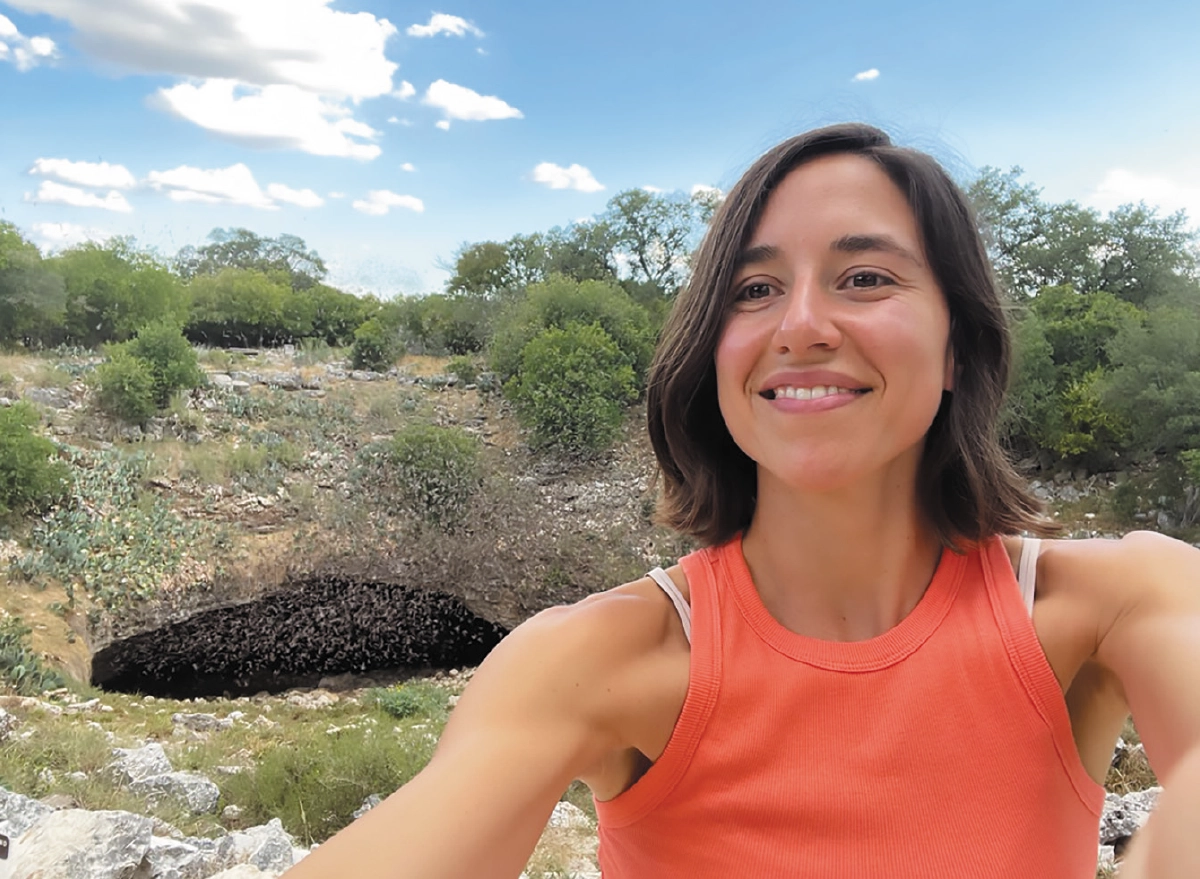
Luz de Wit, Ph.D., at Bracken Cave in Texas
Photo: Luz DeWit, Ph.D.
Why is it critical for BCI to accurately locate and monitor Mexican free-tailed bat colonies?
Monitoring helps anticipate human-bat interactions and allows managers to protect colonies and reduce stress. Mexican free-tailed bats play a key role in controlling agricultural insect pests, so protecting their roosts helps maintain this ecosystem service, which benefits farmers, influences pesticide use, and can ultimately benefit consumers.
How does a lack of knowledge about which bridges are used by bats pose a threat to the species?
Without knowing which bridges are important for bats, maintenance or demolition could disturb or destroy roosts, threatening local bat colonies. Surveying all bridges is logistically impossible, so there is a need to prioritize which bridges to check to efficiently protect bat colonies.
What data points were most crucial in building this predictive model?
The model incorporated bridge-specific features, landscape characteristics, and climate variables. To confirm the relationship between these variables and bat presence, the team conducted ground-truth surveys at 380 bridges, recording whether bats were present or absent. The survey data were then used to “train” the model, allowing it to predict the probability of bat presence across all bridges in the Southwestern U.S. that were not directly surveyed.
What was the most significant finding from the analysis?
A couple of key findings from the model are that bridges over water were more likely to have bats, while bridges in urban areas were less likely to host them. Another important takeaway is that the tool is especially good at identifying bridges where bats are unlikely to be present, which can help managers focus their time and resources on the sites that matter most.
Once a bridge is identified as a high-probability roost, how is that information used?
By focusing surveys on bridges with higher likelihoods and spending less effort on those with low probabilities, agencies can make their monitoring more efficient and cost-effective. Decisions about protection or mitigation efforts, however, remain the responsibility of each organization and are not determined by the tool itself.
What is the ultimate goal of the predictive tool?
The tool’s main purpose is to make surveys more efficient so that the people conducting them—whether they are agencies, conservation groups, or engineers—can better target their conservation or mitigation efforts. By improving survey efficiency, we hope to better support the broader conservation of Mexican free-tailed bats and the vital ecosystem services they provide.