field notes
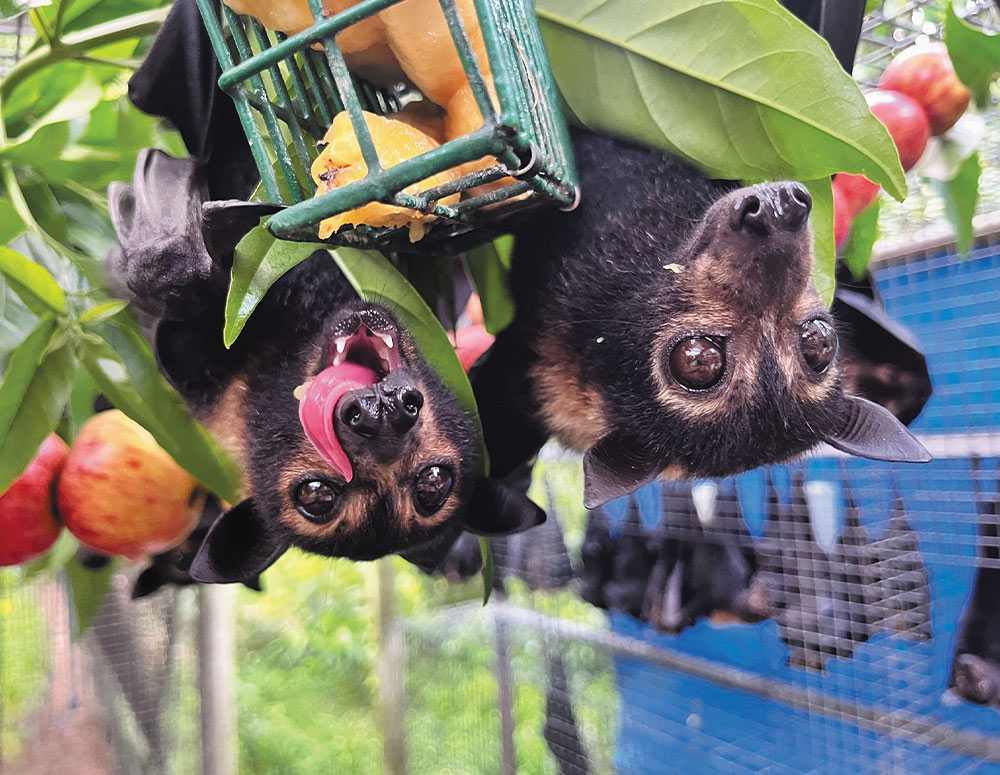
Two young spectacled flying foxes hang upside down while eating fruit from a green wire feeder. One bat has its pink tongue extended. They are surrounded by green leaves and red fruit in an outdoor enclosure with a blue mesh background.
Dinner time for two young spectacled flying foxes (Pteropus conspicillatus).
Photo: Vivvy Hsieh

Tolga Bat Hospital

Take a peek inside one of the longest-running bat rescue and rehabilitation centers in the world
By Stefanie Waldek

Australia is famous for its wildlife, from kangaroos to koalas to kookaburras. But perhaps the country should have another ambassador, one with expressive brown eyes, velvety wings, and a talent for pollinating the rainforest—the Endangered spectacled flying fox (Pteropus conspicillatus). In the Atherton Tablelands of Queensland, the Tolga Bat Hospital makes this case every day.

Founder Jenny Mclean wasn’t originally a wildlife expert—she was a physical therapist—but felt compelled to support Australia’s native wildlife. An article in the local newspaper called for volunteers to care for baby flying foxes orphaned when their mothers succumbed to tick paralysis, and Mclean jumped at the opportunity. Armed with simple bat care instructions printed on a single sheet of paper, Mclean took two pups under her wing. The next year, she took four pups. The year after, six.

“After that, I started treating bats with tick paralysis as well, with the help of good mentors,” she says. Soon, everyone knew where to send bat emergencies of all kinds—and the Tolga Bat Hospital was born in 1990.

Once people have the opportunity to meet [the bats] up close, they see for themselves that these little guys are really intelligent and cute.
—Jenny Mclean
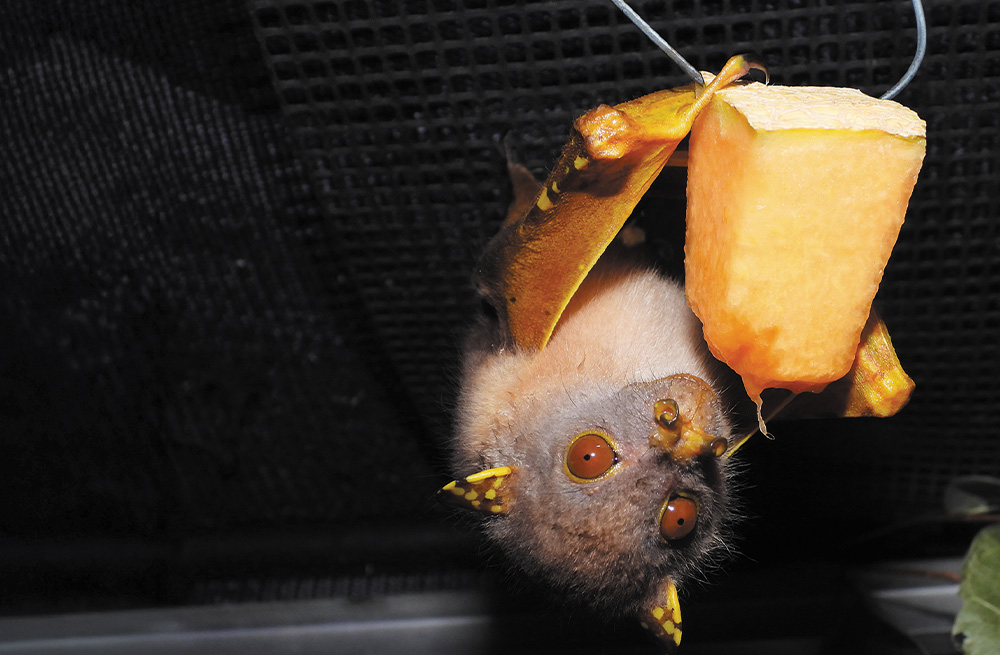
An eastern tube-nosed fruit bat with yellow-spotted ears and orange eyes hangs upside down from a mesh surface. It is positioned next to a rectangular piece of fruit suspended by a wire.
Many tube-nosed fruit bats (Nyctimene robinsoni) come into care each year from entanglement on barbed wire fences.
Photo: Vivvy Hsieh

Aiding and advocating for bats

Rescuing and rehabilitating bats was only the beginning. Mclean quickly realized that the biggest threat facing bats wasn’t just disease, but also public perception. “As soon as you work with bats, you discover that nobody cares about bats. In fact, many people actively dislike them,” she says.

Her solution was to invite the public in. “Once people have the opportunity to meet them up close, they see for themselves that these little guys are really intelligent and cute,” Mclean says.

This approach worked so well that Tolga became the top-rated attraction in the region on TripAdvisor, bolstered by Advanced Ecotourism accreditation from Ecotourism Australia. Tourism not only provides income for the hospital but also creates bat advocates.

One of those advocates is Amanda M. Adams, Ph.D., Director of Research Coordination at BCI. In 2007, before she joined BCI, Adams spent four months volunteering at Tolga. “I was at the beginning of my journey into bat conservation,” she says. “It was the best experience of my life.”


A new challenge—and opportunities

Today, the Tolga Bat Hospital continues its rescue and rehabilitation work, but it’s not only tick paralysis threatening flying foxes. Barbed wire fences are also a major cause of injury to Mclean’s patients, so she and her team advocate for wildlife-friendly fencing.

Another issue affecting the spectacled flying fox population in the Atherton Tablelands is cleft palate syndrome. While the bat hospital has always seen a handful of cases each year, there’s been a worrying spike. “In 2024, we had 75 cleft palate syndrome cases, and that was double what we ever had before,” Mclean says. “Then in 2025, we saw the number doubled again at 137.” Early findings suggest that an environmental toxin interacts with a gene, causing cleft palate, but further research is needed to confirm the theory.

That’s where the bat community can make a difference. Tolga Bat Hospital is actively seeking collaborators, including researchers interested in solving the mystery of bats with cleft palates, volunteers willing to lend their time, or donors who want to support Australian bat conservation. After all, if Australia can celebrate its kangaroos and koalas, surely there’s room for one more icon—one that finally deserves its turn in the spotlight.