backpack iconFeature: Kenya
BCI’s work in Kenya protects Endangered Hildegarde’s tomb bats (Taphozous hildegardeae) and other species.
Photo: Horizonline Pictures

Protecting the Bats of Kenya’s Coastal Caves

Protecting the Bats of
Kenya’s Coastal Caves
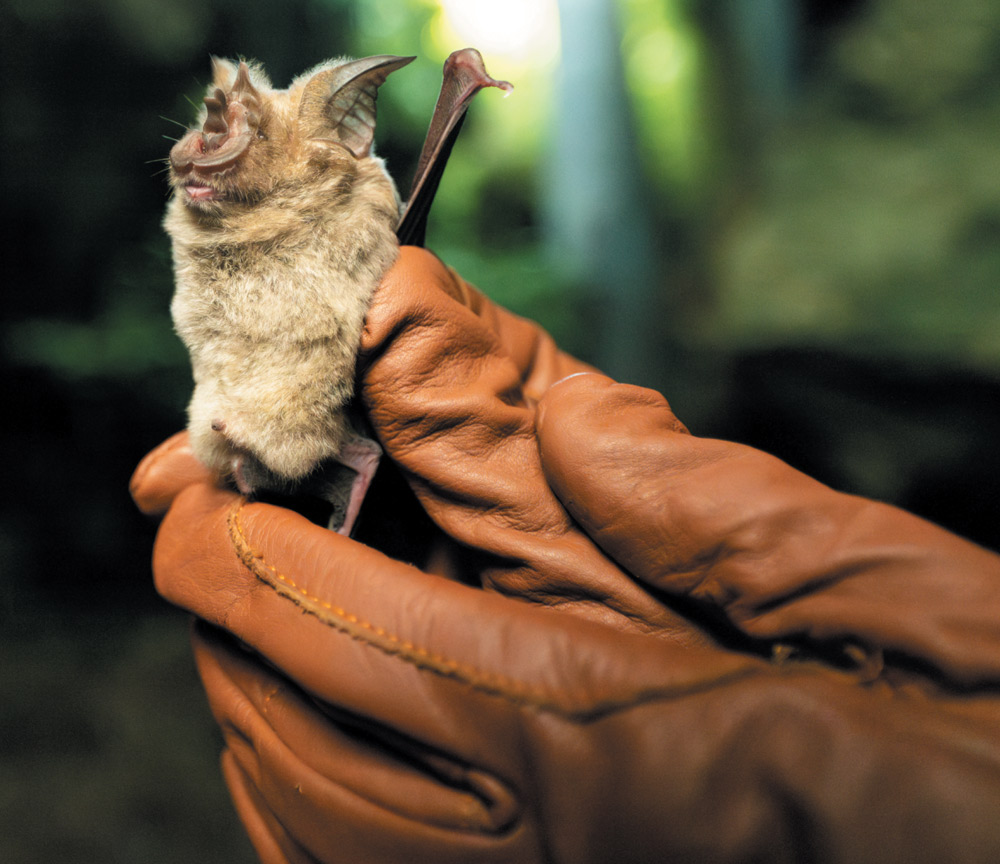
Close-up of a small, fluffy bat being held gently in a person's hand wearing thick brown leather gloves.
A horseshoe bat at the Three Giant Sisters Caves near Fikirini.
Photo: Horizonline Pictures
S

eventy percent of the Endangered Hildegarde’s tomb bat (Taphozous hildegardeae) population in Kenya is concentrated in just two locations: the Kaboga and Makuruhu caves that are located near Watamu, a rapidly developing tourist destination, and the Tswaka Three Giant Sisters Caves outside rural Fikirini Village.

In these locations, as well as throughout coastal Kenya, Endangered bats are threatened by habitat loss, deforestation, and urban expansion, as well as disturbance of cave roosts. To protect these bats, BCI has spent the last three years building relationships with local partners and community members to create positive change for bats and people.

Protecting bats as tourism grows

In 2024, BCI purchased the Kaboga Cave site outside Watamu to protect it and then transferred ownership to sustainable development enterprise Angaza Vijiji so that the site could be locally managed.

“We were worried that the cave would be flattened at some point,” says BCI’s Kenya Program Manager David Wechuli, Ph.D. “If we didn’t hurry, another building would be there.”

bat hanging silhouette icon
Learn more about BCI’s Kenya work: batcon.org/nightwatch
A tall corner wall made of gray concrete bricks and pillars on a dirt ground under a cloudy sky.
A perimeter wall protects Kaboga Cave.
Photo: David Wechuli, Ph.D.
Now, a perimeter wall protects the cave along with half an acre of land around it, where vegetation thrives, and Hildegarde’s tomb bats can roost alongside other species like the African trident bat (Triaenops afer) and striped leaf-nosed bat (Macronycteris vittata).

Beyond the perimeter wall, the town is expanding and industrializing to accommodate its growing popularity as a tourist destination on Kenya’s beautiful southeast coast. While Watamu’s development provides a boost to the local economy, it threatens the habitat of the Endangered Hildegarde’s tomb bat.

Evarastus Obura, founder and CEO of Angaza Vijiji, points out the importance of sustainable development, saying, “We can appreciate that development is happening, but how do we develop without compromising the integrity of natural resources around us?”

Now, BCI, Angaza Vijiji, and partners are working to make use of the land within the perimeter wall to benefit the community. Together, they are exploring the possibility of planting demonstration kitchen gardens at the site. These would help communities grow produce both for their own meals and to sell for a small profit, while also keeping the land healthy even as the surrounding modernization continues.


[This project] requires us to be very flexible and adaptable, and to listen closely to our local collaborators and partners. We need to make sure that everyone who needs to be at the same table to discuss what’s going to happen is at that table.
—Isabella Mandl, Ph.D.

Cultivating trust

Around 200 kilometers down the coast from Watamu sits Fikirini Village, where bats live in the Tswaka Three Giant Sisters Caves. When Isabella Mandl, Ph.D., BCI’s Regional Director for Africa & South Asia, began to work together with partners and the village’s residents several years ago, the team learned about the cultural and religious significance of the caves and how the COVID-19 pandemic made residents especially wary of the bats that lived there.

Additionally, Mandl and her team learned that the forest, which served as an important hunting ground for bats, was a vital resource for community members who harvested wood for cooking fires and construction.

When Mandl and other BCI representatives first arrived in Fikirini, they focused on getting to know the local community. “The trust-building phase was the better part of two years,” she says.

A group of people gathering outside a bright orange building with a blue metal roof for a community meeting.
Meeting with the members of the Tswaka community-based organization to discuss the management of the caves and surrounding landscape.
Photo: Isabella Mandl, Ph.D.
A researcher from Batcon.org standing inside a large cave looking up at a rocky ceiling illuminated by light.
Coral limestone caves are fragile ecosystems.
Photo: Jon Flanders, Ph.D.
BCI’s team met with community members and shared how the bats benefit residents by pollinating crops, eating the mosquitoes that spread malaria, and drawing potentially profitable ecotourism to the area. “After we had meetings and education hours with community members, they began to appreciate why they should be part and parcel of this initiative to protect the caves,” Wechuli says.

The creation of a community-based organization (CBO) established local leadership structures for organizing conservation work. Fikirini and BCI worked together to create two tree nurseries that are now growing more than 20,000 native tree seedlings. While they were originally only intended to reforest the conservation site, the nurseries have been so successful that the village is now selling seedlings and trees to the Kenyan government and other organizations seeking to restore forest areas across the coast.

This initiative is part of BCI’s training program designed to provide multiple streams of income for individuals and the community. Some of the training opportunities offered have included catering, handicrafts, and the construction of energy-efficient clay stoves.

Rows of green Tamariandus indica plants growing inside a mesh-covered greenhouse nursery with a sign.
The community grows native trees for reforestation in the conservation area and broader landscape.
Photo: Isabella Mandl, Ph.D.

Planning for the future

Many of these training sessions are in anticipation of the day when coastal Kenya’s expanding tourism industry comes to Fikirini. Although Fikirini village is more rural and farther inland than many current destinations, including Watamu, tourists interested in seeing the bats and the caves where they live are already paying occasional visits.

Within the last year, BCI has worked alongside those in Fikirini to build an Information Center to serve as a hub for both future tourism and the CBO’s operations. As the CBO has become more established, it has coordinated more closely with the county government to address local issues of interest to the community.

Mandl says that one of the fiercest advocates for truly sustainable tourism she’s worked with in Kenya was Ali Toya, a longtime BCI collaborator and bat guide who passed away in 2025.

“Ali was a force of nature,” Mandl says. “He was telling me about all these great ideas to promote ecotourism, how we could get tourists interested but not disturb the bats. The community already had a way of thinking about how to protect the site.”

bat in flight icon
Learn about sustainable development enterprise Angaza Vijiji: angazavijiji.co.ke
Going forward, Mandl is optimistic about how these projects in Kenya will continue to progress, and what the organization can learn about continuing to improve on its sustainability initiatives.

“It requires us to be very flexible and adaptable, and to listen closely to our local collaborators and partners,” she says. “We need to make sure that everyone who needs to be at the same table to discuss what’s going to happen is at that table.”

Hildegarde’s Tomb Bat

The Endangered Hildegarde’s tomb bat (Taphozous hildegardeae) lives in coral caves along the coastlines of Kenya and Tanzania and has a very limited range. By protecting the Kaboga and Makuruhu caves, as well as the Tswaka Three Giant Sisters Caves, BCI hopes to allow the bats to thrive. This will also create an opportunity to learn more about this mysterious bat.

“I’m looking forward to having a concerted effort for conservation, but also working with our colleagues in the country to do research to understand these animals’ behavior,” says BCI’s Kenya Program Manager David Wechuli, Ph.D. “We need to understand their population dynamics and feeding patterns.”

Isolated view of a bat in mid-flight with its wings fully extended, showcasing detailed wing structure.
Endangered Hildegarde’s tomb bat (Taphozous hildegardeae).
Photo: Paul Webala, Ph.D.
Isolated view of a bat in mid-flight with its wings fully extended, showcasing detailed wing structure.
Endangered Hildegarde’s tomb bat (Taphozous hildegardeae).
Photo: Paul Webala, Ph.D.

Hildegarde’s Tomb Bat

The Endangered Hildegarde’s tomb bat (Taphozous hildegardeae) lives in coral caves along the coastlines of Kenya and Tanzania and has a very limited range. By protecting the Kaboga and Makuruhu caves, as well as the Tswaka Three Giant Sisters Caves, BCI hopes to allow the bats to thrive. This will also create an opportunity to learn more about this mysterious bat.

“I’m looking forward to having a concerted effort for conservation, but also working with our colleagues in the country to do research to understand these animals’ behavior,” says BCI’s Kenya Program Manager David Wechuli, Ph.D. “We need to understand their population dynamics and feeding patterns.”