Field notes Research news from around the globe
Santa Eulalia is one of the sites sharing a migratory connection with Bracken Cave.
Photo: UACH

Sister Roosts

Researchers find migratory connection between Bracken Cave and two former mines in Mexico
By Annika Hipple
E

very summer evening at dusk, roughly 15 million Mexican free-tailed bats (Tadarida brasiliensis) rush out of Bracken Cave near San Antonio, Texas, to feed on insects. Bracken Cave is home to the world’s largest known bat colony, and it has been owned and managed by BCI since 1992. Now, researchers have discovered a migratory connection between this cave and two abandoned mines inhabited by bats in the northeastern Mexican states of Chihuahua and Nuevo León.

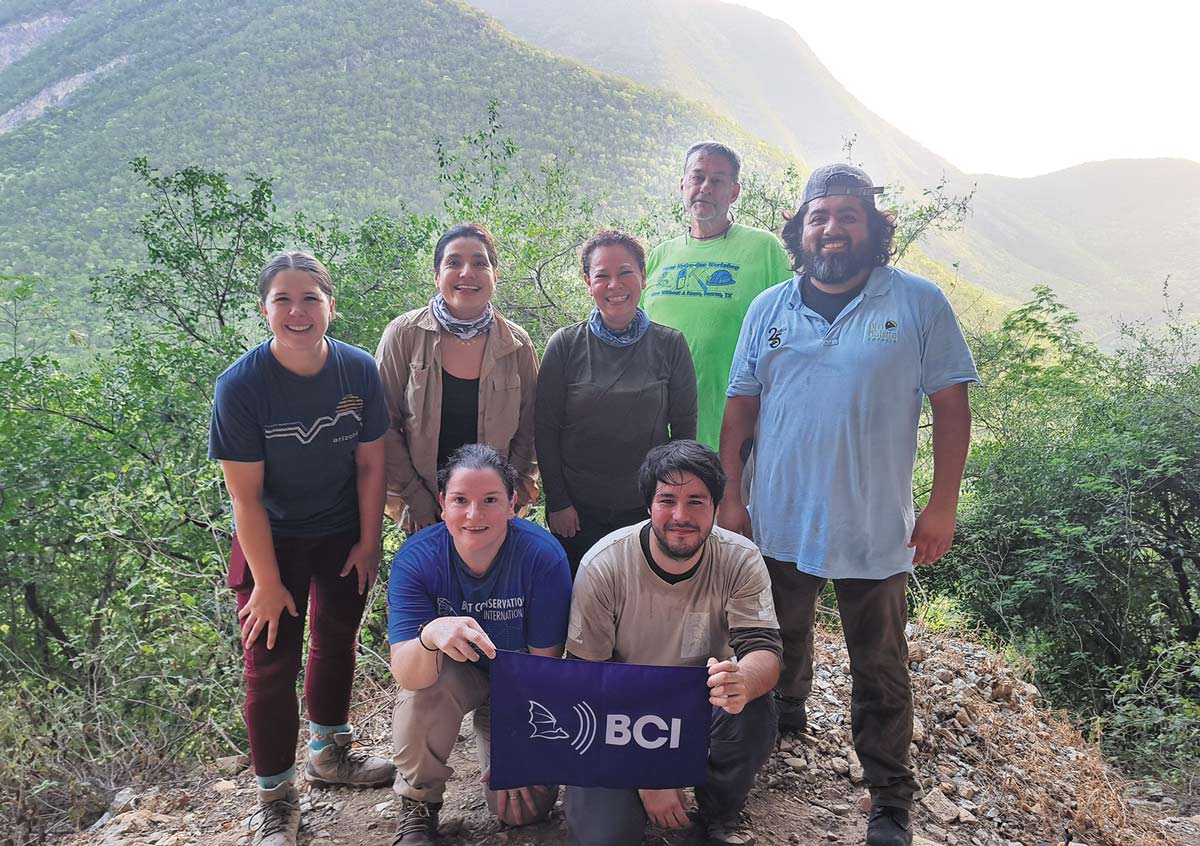
A group of seven researchers poses outdoors on a mountain trail, with two holding a blue Bat Conservation International flag.
BCI and partners visit La Cueva de la Boca to discuss potential monitoring, research, and outreach opportunities for the site.
Photo: Diana Gonzalez
Researchers used data from a network of automated radio telemetry towers for tracking wildlife, known as Motus towers, to track a bat that was recorded at Bracken Cave all the way to Las Cavernas de Santa Eulalia in Chihuahua. Bats that visit both sites are also believed to visit another cave, La Cueva de la Boca in Nuevo León. While researchers are working to learn more about the bats’ movement patterns, BCI scientists say that conservation efforts must be designed to consider a migratory landscape that includes Bracken Cave, as well as its two “sister” roosts in Mexico.

“These roosting sites are connected somehow demographically,” says Ana Ibarra, Ph.D., BCI’s Regional Director, Mexico & Latin America. She says BCI is closely collaborating with other organizations in Mexico since “everything that happens on both sides of the border is impacting the populations on all the migratory routes.” Ibarra and other researchers believe the bats’ movements are likely tied to seasonal insect populations that are correlated with crop growing seasons.

Everything that happens on both sides of the border is impacting the populations on all the migratory routes.
—Ana Ibarra, Ph.D.
In Chihuahua, Sergio Luévano, is a lecturer at the Universidad Autónoma de Chihuahua. He has advocated for the preservation of the Santa Eulalia site since 2018, when he learned about a very large bat colony inside the mine. Luévano says monitoring has revealed that the site is a maternity roost for Mexican free-tailed bats, which start arriving in May and give birth about a month later. These bats spend several months foraging in the area before migrating further south in early November. Studies suggest a genetic relationship between bats from Santa Eulalia and those from Bracken, though there is still much to learn about the degree of migratory connectivity.
Meanwhile, in Nuevo León, the Mexican environmental organization Pronatura Noreste has worked on conservation at La Cueva de la Boca for many years, though the site’s role in the larger ecosystem is not yet fully understood.

Last year, Luévano and Diana González, who coordinates Pronatura’s education and fundraising, visited Bracken Cave. “It was a wonderful exchange of experiences that helped us identify potential avenues for action,” González says. “We even created a map revealing that the connections between these sites form a distinct triangle.” She says their mapping revealed 460 miles (740 kilometers) between Bracken Cave and Santa Eulalia, with 312 miles (502 kilometers) of distance between the Nuevo León site and Bracken Cave.

Fran Hutchins, Director of the Bracken Cave Reserve, appreciates the opportunities for collaboration with partners in Chihuahua and Nuevo León and looks forward to enhancing scientific research and community-based conservation efforts.

“Initially, we’re looking at the ability to do more science and study the bats, their migration habits, and how they’re using these roosts,” Hutchins says. “There are also opportunities for ecotourism and education for the communities that are around these roosts, so the bats become ‘their’ bats as they come to appreciate the bats’ value. Because at the end of the day, we can’t protect something on somebody else’s land. The people who live there are the ones who have to protect it.”