










Bat Week October 24-31

Bat Conservation International Bats Magazine

Bats Magazine logo
The State of India's Bats
Report brings researchers together to conduct nationwide assessment
Bat Conservation International logo
Volume 45 • Issue 3
Photo: Jonathan Alonzo
Ways To Give Advertisement
Issue 3 2026

Inside this Issue

Bats magazine logo
14
Photo: Rohit Chakravarty, Ph.D.

Features

08Beyond the bats

Meet the volunteers of Bracken Cave Preserve
14The State of India’s bats

Report brings researchers together to conduct nationwide assessment
Departments

02Off the Bat

A note from BCI’s new Executive Director, Daphne Carlson, DVM, Ph.D.
06Species Study

Working to save Kenya’s Harrison’s large-eared giant mastiff bat (Otomops harrisoni)
24Bat Chat

BCI’s Director of White-Nose Syndrome Research discusses promising vaccine developments
25Bat Squad

Conserving habitat benefits bats, frogs, and other species
Read past issues of Bats Magazine at batcon.org/batsmag

news & updates

Photo: Jennifer Barros, Ph.D.
19
3Bat Signals

Conservation news and updates
  • Pemba flying fox population grows
  • Saving bats in Singapore
  • Documentary showcases tent-making bats
  • A win for bats at UN meeting
  • New conservation group in Indonesia
  • Celebrate Bat Week
  • Become a Bat Ambassador
18Field Notes

Research news from around the globe
  • Brazil’s hot caves
  • Training wildlife professionals in New Mexico
  • Gila National Forest project
  • Ancient bats
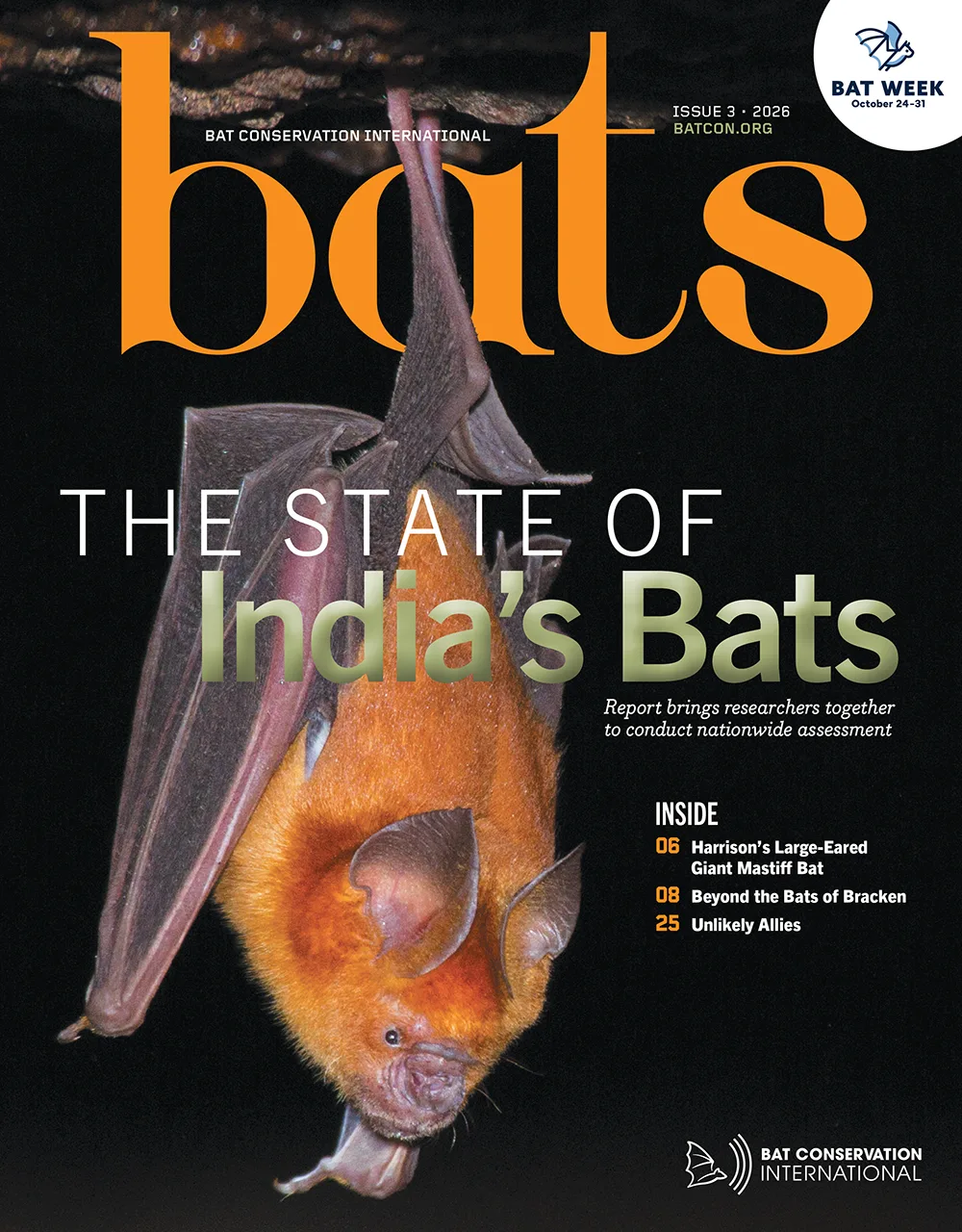
Bats Magazine Volume 45, Issue 3 cover
ON THE COVER:
Schneider’s leaf-nosed bat (Hipposideros speoris) is a common species found in Central and Southern India. It’s a small- to medium-sized bat weighing about 9–13 grams, and roosts in colonies ranging from 50 to 2,000 individuals.
Image: Rajesh Puttaswamaiah
off the bat
A few words of introduction from your friends at Bat Conservation International

A Note from Our New Executive Director

Daphne Carlson, DVM, Ph.D.
S

mell announces the bats before sight. The sharp aroma of 15 million bats carried on a cool evening after the rains. Recent storms had grounded the colony the night before, so tonight they were hungry. Scout bats tested the air first, darting in tight loops. Then the waves of bats came in quick succession, creating a spiraling mass at the cave mouth before the column bent southeast toward the agricultural fields, the stream of bats swaying left and right like one breathing organism. When the wave swayed directly overhead, the wing beats stirred a breeze against my skin and filled the air with a low, steady drumming. It looked like a waterfall running upwards, with no visible end.

Despite being born and raised in Texas, this was my first Bracken experience, in the days before I officially stepped into this role. What stayed with me wasn’t just the scale, though I’m still not sure how to process 20 million of anything. It was the thought that this same thing was happening in roosts and caves around the world that night, and that Bat Conservation International’s work is what stands behind protecting them.

Masthead

Bat Conservation International logo
Bat Conservation International (BCI) is a 501(c)(3) organization dedicated to protecting bats and their essential habitats around the world. A copy of our current financial statement and registration filed by the organization may be obtained by contacting our office in Austin, Texas, address below, or by visiting batcon.org.

Main Office

500 N Capital of TX Hwy, Bldg 8, Suite 225
Austin, TX 78746, USA
512-327-9721

Managing Editor

Kristen Pope

Editor-in-Chief

Kathryn Slater

Contributors

Michelle Donahue / Proofreader

Publication Management BackPocket Agency

Bats Magazine welcomes queries from writers. Send your article proposal in a brief outline form and a description of any photos, charts, or other graphics to the Editor at pubs@batcon.org.

Members: We welcome your feedback. Please send letters to the Editor to pubs@batcon.org. Changes of address may be sent to members@batcon.org or to BCI at our Austin, Texas, address above. Please allow four weeks for the change of address to take effect.
Board of Directors
Andrew Sansom, Ph.D., Chair
Danielle Gustafson, Vice Chair
Ann George, Secretary
Gerald Carter, Ph.D.
Gary Dreyzin
Shahroukh Mistry, Ph.D.
Cecily Read
Sandy Read
Dan Riskin, Ph.D.
Nancy Simmons, Ph.D.
Science Advisory Committee
Luis Aguirre, Ph.D.
Enrico Bernard, Ph.D.
Sara Bumrungsri, Ph.D.
Gerald Carter, Ph.D.
Charlie Chester, Ph.D
Liliana Dávalos, Ph.D.
Brock Fenton, Ph.D.
Tigga Kingston, Ph.D.
Gary McCracken, Ph.D.
Stuart Parsons, Ph.D.
Paul Racey, Ph.D.
Danilo Russo, Ph.D.
Nancy Simmons, Ph.D.
Paul Webala, Ph.D.
Senior Staff

Daphne Carlson, DVM, Ph.D., Executive Director
Mylea Bayless, Chief of Engagement
Winifred Frick, Ph.D., Chief Scientist
Kevin Pierson, Chief of Conservation and Global Strategy
Gift Venezio, Chief Operating Officer

Visit BCI’s website at batcon.org and the following social media sites:

Bat Signals BCI updates and conservation news
Pemba flying foxes (Pteropus voeltzkowi) on Pemba Island.
Photo: Tammy Mildenstein, Ph.D.

Pemba Flying Fox Population Grows

Urban habitats lead to concerns about coexistence
I

n 2024, BCI supported an island-wide survey of the endemic Pemba flying fox (Pteropus voeltzkowi) on Pemba Island, which is part of Tanzania’s Zanzibar Archipelago. The project, led by Conservation Biologist and Fruit Bat Specialist Tammy Mildenstein, Ph.D., and University of Bristol Professor Tim Caro, Ph.D., recorded a large, stable bat population, which they attributed, in part, to past conservation and awareness campaigns.

The research team visited 64 roost sites, yielding an estimated 27,000 Pemba flying foxes. This is a massive increase over the 5,000 bats that were estimated to live on the island in 1995. However, they found that 90% of the island’s bats are roosting in large groups in urban areas, in contrast to the smaller colonies in villages or forests found in 1995. The team suggests this shift is due to disturbances in the bats’ previous roost locations.

Having large groups of bats in urban areas could lead to human-bat conflicts, so the study’s authors stress the importance of establishing bat roosting sanctuaries in protected natural areas away from city centers.

Read the study in Oryx: doi.org/10.1017/S0030605325102238

bat signals

Saving Bats in Singapore

University students form bat rescue network

A group of people standing together outdoors behind a picnic spread on the lawn.
Students at Singapore’s Nanyang Technological University formed an observation network to monitor grounded bats
Photo: NTU Grounded Bat Surveys
When undergraduate student Emma Chao entered Nanyang Technological University (NTU) in Singapore, she learned from senior students that there were numerous grounded bats on the campus. She joined with other students to start formal monitoring based on their observations.

The students established a Bat Response Hotline that takes reports of grounded, injured, and dead bats. The group also conducts regular monitoring efforts and surveys. Most of the bats they find are young Javan pipistrelles (Pipistrellus javanicus), with occasional reports of other species. Doctoral student Nicole Dorville is helping oversee their efforts.

Chao’s surveys began in 2024. Today, 40–50 students assist with monitoring, response efforts, and walking transects in search of grounded bats. When they find a bat in need, they conduct no-contact measurements and observations and alert local wildlife officials. The students aim to conduct a monthly bat census, through which they hope to learn more about groundings, urban bat viability, and animal fitness.

Species Study
There are 1,500+ species of bats in the world. This is one of them.

Harrison’s Large-Eared Giant Mastiff Bat

Species at risk despite a large population in Kenya
By Annika Hipple
bat stats
Bat icon
Binomial

Otomops harrisoni
Two bats icon
Family

Molossidae
Bat Globe icon
Colony Size

Up to millions
Scale icon
Weight

26.8–45 g
Bug icon
Diet

Insectivorous
Exclamation Point icon
Status

Vulnerable
Region

Djibouti, Eritrea, Ethiopia, Kenya, Yemen
Black graphic silhouette map of Africa, the Middle East, and parts of Europe against yellow.
Harrison’s large-eared giant mastiff bat
Photo: Isabella Mandl, Ph.D.
C

an a bat be both abundant and Threatened at the same time? In the case of the Harrison’s large-eared giant mastiff bat (Otomops harrisoni), the answer might be yes. Known from only two cave roosting sites located about 500 miles apart in Kenya, this bat was only recognized as a distinct species a decade or so ago, based on genetic evidence distinguishing it from its sister species, the large-eared free-tailed bat (Otomops martiensseni).

The Kenyan caves where the species roosts range from large basalt tubes to vast, high-ceiled cave chambers. One roosting site, Chyulu Hills, is a national park, while the other, Mount Suswa, is a community conservancy managed by local community representatives.

plant iconFeature: Bracken Cave

Beyond the Bats

Beyond the Bats
Meet the volunteers of Bracken Cave Preserve
By Jill Robbins
Bracken Cave Preserve relies on a dedicated group of volunteers.
Photo: Don and Edith Bergquist
Meet the volunteers of Bracken Cave Preserve
By Jill Robbins
M

ost people come to Bracken Cave Preserve for the bats, since it’s home to the largest known bat colony in the world. On summer evenings north of San Antonio, visitors gather in the viewing area, waiting for the first movement at the cave mouth. Then the spiral begins: more than 15 million Mexican free-tailed bats (Tadarida brasiliensis) pour into the sky in an inky black ribbon that twists upward before spreading across the Hill Country.

What most visitors don’t see, or even think about, is what happens before and after the bat flights.

Earlier that same day, volunteers may have been clearing trails in the Texas heat, leading a butterfly survey, searching for hard-to-find Endangered plants, or teaching children why bats matter to Texas ecosystems.

plant iconFeature: India’s Bats

The State of India’s Bats

The State of India's Bats
Leisler’s bat (Nyctalus leisleri) is found in India.
Photo: Rohit Chakravarty Ph.D.
F

or decades, India’s bats have largely lived in the shadows. Not just at dusk when they emerge to forage, but also in terms of conservation awareness.

India is home to 135 species of bats, making it one of the world’s richest countries for bat diversity. The country’s bats pollinate flowers, disperse seeds, regenerate forests, and consume enormous numbers of agricultural pests. Yet despite their ecological importance, bats have rarely received the attention afforded to tigers, elephants, rhinos, or other species that fit in the category of “charismatic megafauna.”

That is one reason the new “State of India’s Bats” report represents such an important milestone.

Developed through a collaborative effort by researchers, conservationists, and institutions from across the country, the report is the first comprehensive assessment of India’s bats and the challenges they face. More than a status update, it serves as a roadmap for future research, conservation action, and public engagement.

Field notes Research news from around the globe
The entrance of one of the first hot caves that was confirmed in the Cerrado biome.
Photo: Jennifer Barros, Ph.D.

Hot on the Trail of Brazil’s Bat Caves

Hot caves are vital bat habitat
By Stefanie Waldek
S

tep into one of Brazil’s hot caves and you’ll immediately understand how they earned their name. Temperatures can reach 104 degrees Fahrenheit (40 degrees Celsius), humidity approaches 100%, and the air feels more like a sauna than a cave. But the heat doesn’t come from geothermal activity. “It’s the bats,” says BCI’s Brazil Program Manager Jennifer Barros, Ph.D.

For years, Barros has studied hot caves, rare systems occupied by enormous colonies of bats from the Mormoopidae family. The bats congregate by the tens or even hundreds of thousands in specifically shaped cave environments where they can generate enough body heat to keep their pups—which are born without fur—warm. Their guano contributes to the process as well, fermenting and generating additional heat.

“They are creating the environment that they need to survive and thrive in,” Barros says. The result is a unique ecosystem that supports not only the bats themselves, but a broader community of cave-dwelling wildlife.

field notes

Teaming Up to Protect Bats

Training prepares 20 wildlife professionals to monitor bats in New Mexico
By Jessie Bunkley
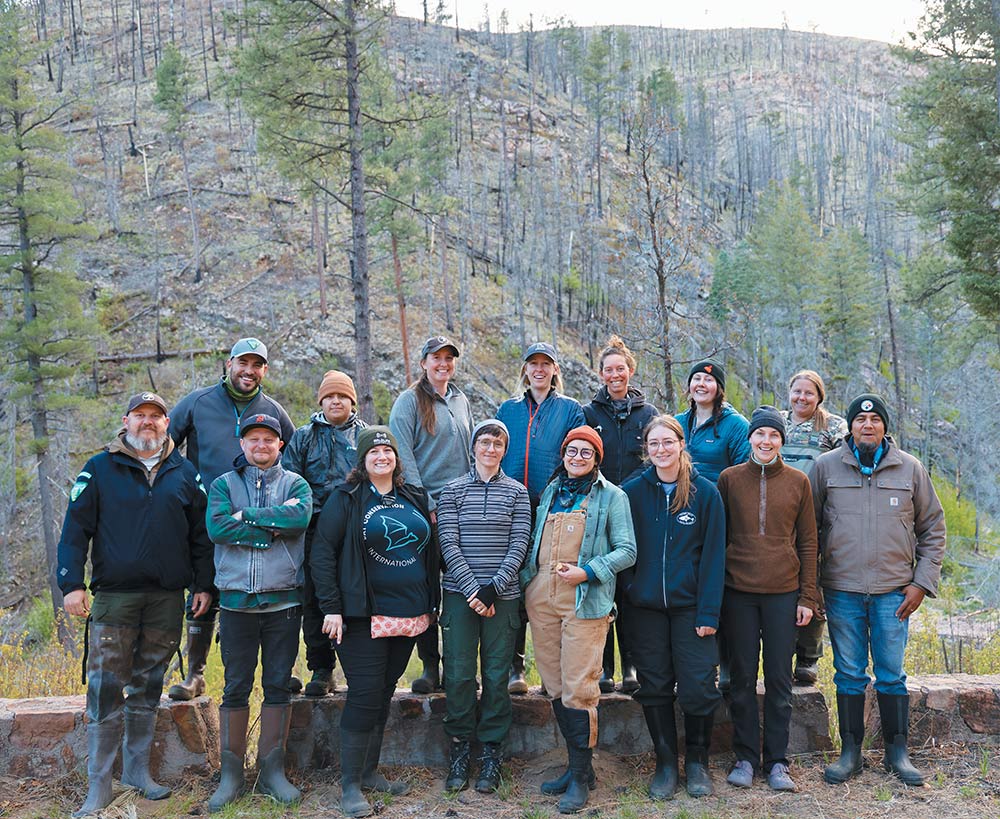
Group of researchers and conservationists posing outdoors in front of a wooded hillside.
Biologists from BCI, U.S. Forest Service, Bureau of Land Management, and New Mexico Game and Fish prepare to capture bats in Gallinas Canyon in the Santa Fe National Forest.
Photo: Rachel Harper
T

he wide beam of my spotlight illuminates a small, furry creature suspended in mid-air. The bat is caught in a fine net stretched over Gallinas Creek in the Sangre de Cristo mountains in northern New Mexico. As one of BCI’s biologists and trainers on the project, I guide a fellow scientist through the process of untangling the bat. First, we identify which side of the net it entered from. Then, we slowly work the fine strands off the bat’s back and over its elbows, wrists, and head.

It’s 8 p.m., and our work is just beginning. We are surrounded by the soothing sounds of the creek, the brilliance of the night sky, and great bat habitat. Looming in the distance is the bare-rock face of Hermit’s Peak, and a ponderosa pine forest surrounds us. Some trees are green while others are charred. This canyon was caught in the confluence of the Hermit’s Peak and Calf Canyon fires, which together in the spring of 2022 burned 340,000 acres, making it the largest recorded wildfire in New Mexico’s history.

field notes
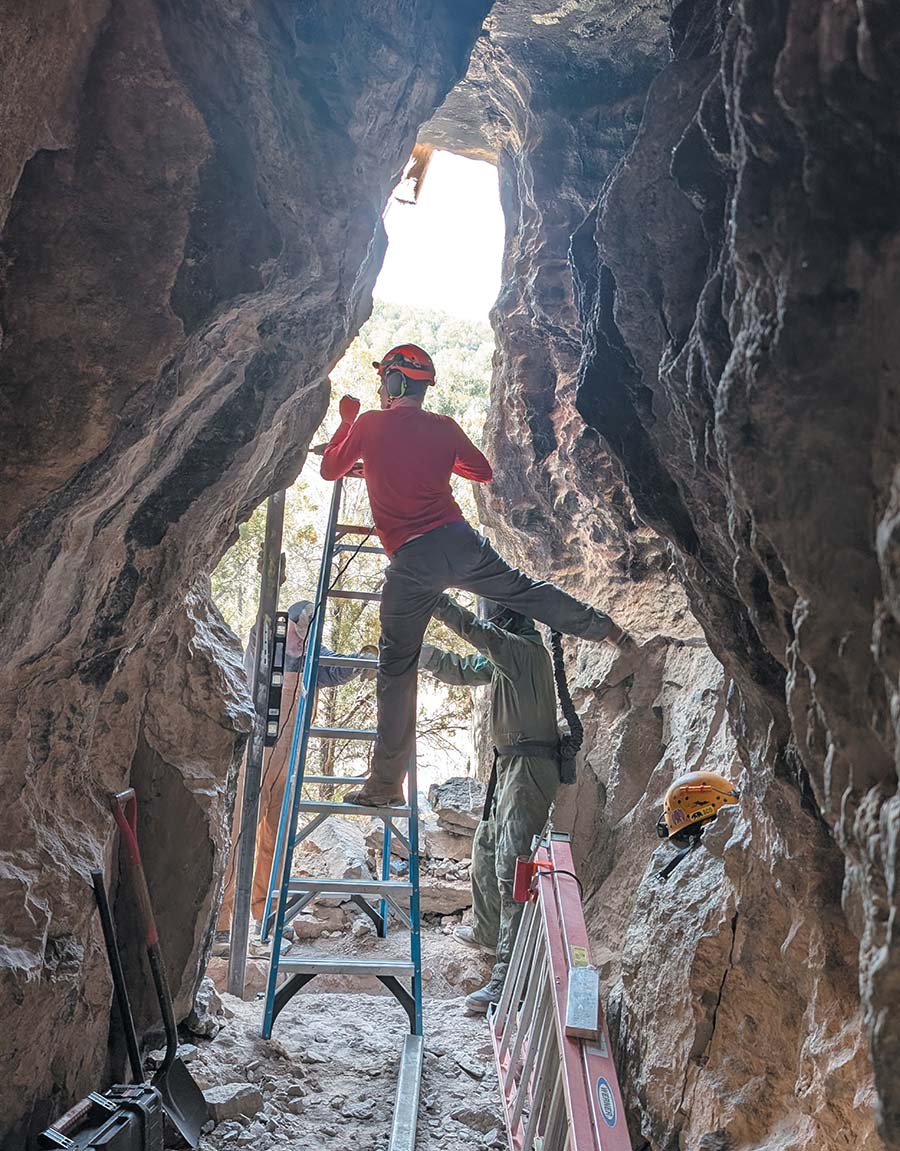
Workers in helmets and protective gear using ladders inside a narrow cave opening.
Protecting the cave entrance will protect bats, Pleistocene relics, and Native American pictographs.
Photo: MineGates

A Win for People and Bats

Gila National Forest project protects important cave site
By Paul Hormick
T

his spring, BCI coordinated with the U.S. Forest Service and Tribal Nations to install bat gates for a cave in New Mexico’s Gila National Forest. The gates, which were built and installed by MineGates Environmental, now protect Pleistocene relics, Native American pictographs, and bats.

The cave branches through hundreds of feet of subterranean habitat, with multiple openings above ground. BCI’s Senior Habitat Restoration Specialist Dan Taylor says protecting such a cave is important for bats.

“The more complex a cave, the better, because these caves have habitats with different microclimates that bats can take advantage of,” Taylor says. “Some parts of a cave may be cooler, therefore better for hibernation. Others are much warmer and better for birthing and raising pups. This cave, with its complex structure and multiple openings, is such a cave.”

field notes

Ancient Bats

50,000-year-old bats found in Grand Canyon cave
E

very year, millions of visitors gaze upon the famous vistas of Grand Canyon National Park, but few see its hidden inner world of caves. A small number of dedicated cave researchers have been quietly exploring and documenting this underground world and recently made an unusual discovery: thousands of desiccated bats, scattered along miles of a cave’s passageways.

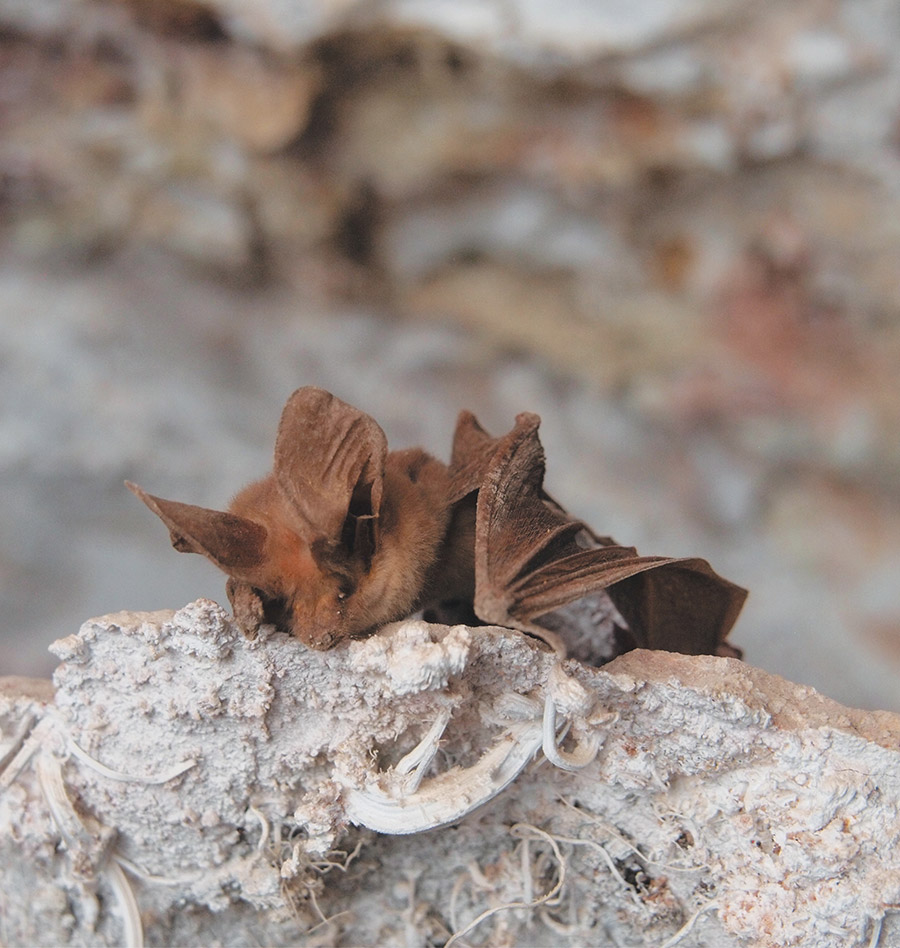
A brown bat with large ears resting on a rough rock surface in a cave.
Pallid bat (Antrozous pallidus) on the cave floor.
Photo: Shawn Thomas
The cave served as nature’s perfect museum, with the dry, stable environment preserving the animals after they died of natural causes. Since the discovery, researchers evaluated some specimens’ ages through radiocarbon dating and found the bats are thousands of years old. Some specimens even exceeded the upper limit of radiocarbon dating, meaning they are more than 50,000 years old.

These initial results demonstrate that bats have continuously occupied the cave system for millennia, illustrating the importance of caves, which serve as habitat anchors through changing climate eras.

Bat Chat A Conversation with a noted expert

A New Hope in the Fight Against White-Nose Syndrome

BCI’s Director of White-Nose Syndrome Research discusses promising vaccine developments
By Stefanie Waldek
T

ina Cheng, Ph.D., BCI’s Director of White-Nose Syndrome (WNS) Research, collaborates with scientists, wildlife managers, and policy makers across North America to better understand WNS and develop tools to combat it. Among the most promising tools is a groundbreaking fungal vaccine developed by researchers at the U.S. Geological Survey (USGS) that has been shown to reduce disease severity and increase survival in vaccinated bats.

What is WNS, and why is it such a threat to bats?

WNS is a disease caused by an invasive fungal pathogen, Pseudogymnoascus destructans (Pd). Pd is believed to have been introduced to North America in the mid-2000s, likely from Eurasia, where it is endemic. There are a dozen bat species that have contracted WNS in North America, but three species have been particularly hard hit: the little brown bat (Myotis lucifugus), tricolored bat (Perimyotis subflavus), and northern long-eared bat (Myotis septentrionalis).
Bat Squad For the young conservationist

Unlikely Allies

Conserving habitat benefits bats, frogs, other species
By Lindsay Lee Wallace
Close-up of a spotted green frog resting on a leaf in water.
A Chiricahua leopard frog (Rana chiricahuensis).
Photo: George Andrejko
S

cientists and conservation partners in the southwestern U.S. are working to forge an alliance between two unlikely creatures: bats and frogs.

The region supports the greatest diversity of bat species in the country, including species like the Mexican free-tailed bat (Tadarida brasiliensis), spotted bat (Euderma maculatum), pallid bat (Antrozous pallidus), and many others. It’s also the home of other unique animals, including the Chiricahua leopard frog (Rana chiricahuensis), which is classified as a Threatened species.

Photo: Lisa Murdock
Batcon Shop Advertisement
Bats Magazine logo
Thanks for reading our latest issue!